Key Notes
- ARK Invest projects an expected Tesla share price of approximately $4,400 in 2031, nearly 12 times the October 19 closing price.
- Robotaxis account for roughly 80% of Tesla’s projected enterprise value in the investment manager’s model, making commercial autonomy the central assumption.
- Tesla reports third-quarter earnings on October 21, providing a nearer-term check on margins, cash generation and funding for new businesses.
Cathie Wood’s ARK Invest forecasts Tesla Inc. (NASDAQ: TSLA) shares could reach approximately $4,400 in 2031, with autonomous ride-hailing accounting for most of the value in its updated model.
The estimate, published October 19, is ARK’s expected outcome, rather than Tesla guidance. Its illustrative base case implies a $17.5 trillion equity valuation.
Tesla closed Monday at $368.06, up 3.76%. The target is nearly 12 times that price, equivalent to approximately 1,095% upside. That comparison describes the distance to ARK’s forecast, rather than an expected near-term share-price move.
ARK Sets Out a Range of Outcomes
The investment manager’s scenarios for 2031 include:
- A bear-case share price of approximately $3,300.
- An expected value of approximately $4,400.
- A bull-case share price of approximately $5,000.
The bear and bull figures represent the 25th and 75th percentiles of simulated outcomes. They are not the lowest and highest prices Tesla could reach, and the lower scenario should not be interpreted as a floor under the stock.
ARK’s model repository describes 5,000 Monte Carlo runs, with assumptions feeding through vehicle-pricing, ride-hailing adoption and valuation calculations. This approach varies inputs repeatedly to explore possible results instead of relying on a single fixed operating forecast.
A distribution is only as useful as the assumptions behind it. If the selected ranges leave out a prolonged setback or overestimate a new market’s profitability, running more simulations does not resolve that underlying uncertainty.
Robotaxis Carry Most of the Valuation
ARK assigns roughly 80% of Tesla’s projected enterprise value to robotaxis. Its illustrative base case includes 8.1 million robotaxi vehicles and $753 billion in annual ride-hailing net revenue by 2031.
That makes commercial autonomy the central investment question. Vehicle production provides the hardware, but a profitable transport network also needs paying riders, sufficient utilization, reliable operations and permission to operate across different jurisdictions.
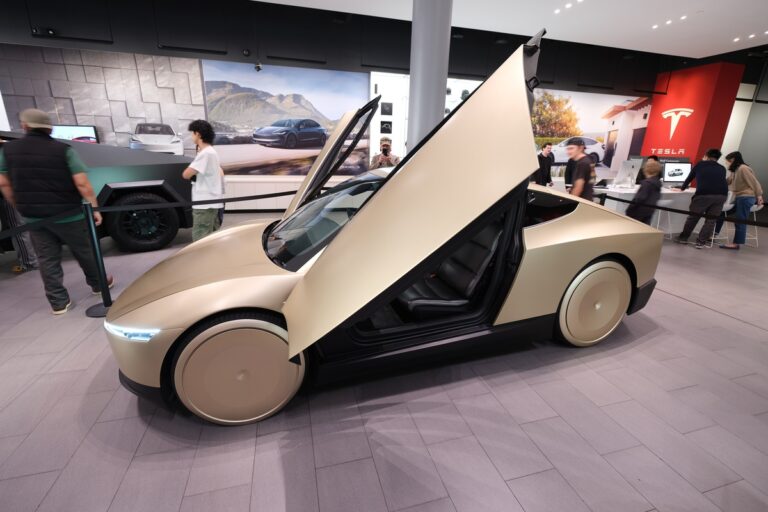
Tesla’s Cybercab production push in Texas, which we previously reported, gives investors a tangible manufacturing development to assess. It does not by itself establish the size, margins or geographic reach of a future autonomous network.
The economics also differ from selling a car once. A ride-hailing operation depends on repeated use over time, while maintenance, cleaning, charging, insurance and periods without passengers can affect what each vehicle earns. Those operating details matter when translating an autonomous-driving capability into shareholder value.
Robotics Adds Another Execution Test
The base-case illustration also includes $212 billion in Optimus revenue and $163 billion in energy-storage revenue in 2031. These are modeled future business results, not current sales or contracted orders.
For robotics, the practical test is whether customers can deploy machines productively enough to justify their cost. Demonstrations and technical progress need to become dependable commercial work before large recurring revenues can be measured.
For storage, the questions include manufacturing capacity, installation schedules and the cash required to support expansion. Growing demand does not automatically translate into the same growth in profit if equipment prices or project costs change.
ARK’s repository explicitly describes its outputs as hypothetical and acknowledges its positive long-term view of Tesla. Publishing the framework makes the assumptions open to scrutiny; it does not independently validate the resulting price target.
Tesla’s Earnings Provide the Next Checkpoint
Tesla’s latest operating update provides a nearer-term benchmark. The company produced 464,391 vehicles and delivered 486,532 in the third quarter, while deploying 13.7 gigawatt-hours of energy storage.
Those are completed-quarter operating figures. Tesla cautions that deliveries and storage deployments alone do not establish quarterly financial performance, which also depends on selling prices, costs, foreign-exchange movements and other factors.
The company is scheduled to release third-quarter financial results after the market closes on Wednesday, October 21. Management’s question-and-answer webcast follows at 5:30 p.m. Eastern time. Investors can follow upcoming reports through our earnings calendar.
Margins, cash generation and investment commitments will offer evidence about the resources available to fund longer-term ambitions. One earnings release cannot settle a five-year forecast, but it can show whether the existing business is strengthening as new activities absorb capital.
The Target Does Not Include a SpaceX Merger
ARK values Tesla as a standalone company for the $4,400 forecast, discussing a possible SpaceX combination separately. Investors should therefore avoid treating the target as a proposed takeover price.
As we reported, Barclays has outlined a potential all-stock combination. That remains an analyst scenario, with no definitive merger agreement or agreed exchange ratio announced in that coverage.
A transaction would introduce a different set of questions, including ownership, dilution, governance and the value of any shares received. For the standalone forecast, the evidence to watch remains Tesla’s ability to turn autonomy, robotics and energy investments into durable cash flows.