Key Notes
- Friedrich Merz urged German companies to use their industrial data for AI, highlighting manufacturers and smaller businesses.
- Nvidia plans investments in four German startups within its wider European commitment, without disclosing individual amounts.
- Germany signed an industrial AI declaration of intent, while Siemens showcased factory applications with workflow-specific efficiency claims.
German Chancellor Friedrich Merz urged businesses to put artificial intelligence to work with their industrial data as Nvidia Corp. (NASDAQ: NVDA) announced planned investments in four German startups and expanded cooperation with the government.
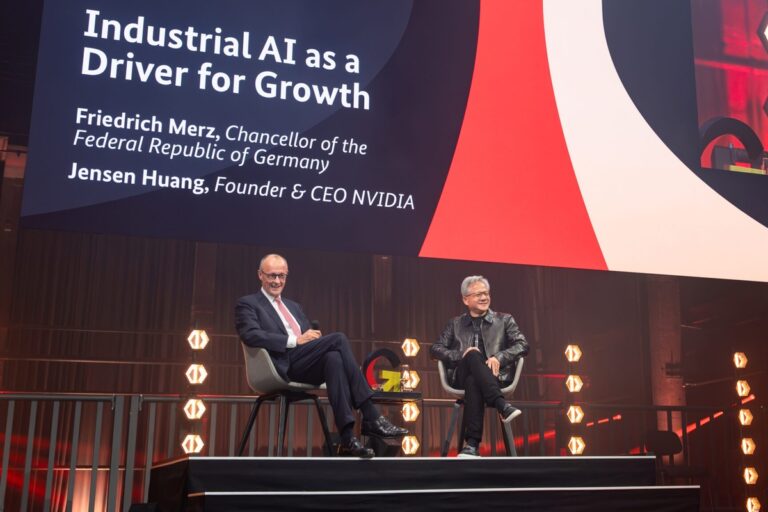
Speaking alongside Nvidia Chief Executive Jensen Huang at the Invest in Germany Summit in Berlin on October 19, Merz singled out manufacturers, machinery companies and automotive suppliers as businesses that could benefit from wider AI adoption. CNBC reported the remarks on Tuesday.
“Please open your doors for AI to make use of your data,” Merz said, according to Nvidia’s account of the discussion. His appeal puts Germany’s established industrial expertise at the center of the opportunity, rather than treating AI as a business confined to software companies.
Germany Formalizes an Industrial AI Initiative
The federal government confirmed that its economy and research ministries signed a joint declaration of intent with Nvidia. The initiative aims to develop models for physical AI, drawing on Germany’s industrial data, manufacturing capabilities and engineering expertise.
The agreement is embedded in the government’s AI roadmap and Platform Industrie 4.0, a network connecting government, companies, researchers and industry associations. The platform is being refocused on industrial AI, with participation open to companies and cooperation extending to international partners.
One area of work involves specialized, open models for industrial applications, building on Nvidia technologies such as Nemotron and Cosmos. The government says involving research institutions and smaller businesses should spread the benefits beyond a few large companies.
A declaration of intent establishes a direction for cooperation. It does not demonstrate that the proposed models are already deployed across German industry or that businesses have realized the productivity gains being sought.
Nvidia Plans Investments in Four German Startups
Nvidia named Agile Robots, Avelios Medical, Mirelo and Reflex Aerospace as new investment targets. It did not disclose the individual amounts. The plans form part of its nearly $10 billion commitment to support companies, universities, research institutions and other organizations across Europe; that figure is not a new allocation solely to Germany.
- Agile Robots: Munich-based robotics developer serving manufacturing, logistics and healthcare.
- Avelios Medical: Developer of hospital information systems that incorporate AI into clinical and administrative workflows.
- Mirelo: Builder of AI models that generate sound effects, speech and music for video.
- Reflex Aerospace: Berlin-based designer and manufacturer of satellites.
The businesses illustrate the breadth of the proposed expansion, from factory automation to healthcare software and aerospace. They also involve different commercial models, so a shared AI label does not establish comparable revenue, financing needs or routes to profitability.
Siemens Shows How AI Could Change Factory Work
Siemens AG (ETR: SIE) offered a more concrete industrial example on the same day. At its electronics factory in Erlangen, the company unveiled applications developed and tested with Nvidia in live production.
For new printed-circuit-board assemblies, Siemens said virtual production preparation can reduce engineering effort by up to 85% and shorten time to market by up to 40%. AI-generated images from digital twins allow inspection systems to be prepared before physical prototypes are available.
Another application generates production-planning options when orders arrive, then checks them against a digital representation of the factory. Siemens said that process can enable cost savings of up to 20%, while helping planners respond to material shortages, delivery requirements and changing orders.
Those are company-stated benefits for particular workflows. They should not be read as an 85% reduction in a factory’s entire workforce or a guarantee that every industrial customer will achieve the same savings. The practical value depends on the task, deployment and operating conditions.
Smaller Businesses Face an Implementation Test
Merz’s focus on the Mittelstand, Germany’s small and medium-sized businesses, reflects a different challenge from simply building more computing capacity. Industrial knowledge is already distributed across suppliers and specialist manufacturers; using it requires connecting data with tools that improve existing operations.
A manufacturer would need to establish which records a model can use, who may access them and how proposed changes are checked before reaching production. Production data can be commercially sensitive, making governance and integration part of the adoption decision.
Huang argued that AI would strengthen Germany’s existing expertise. That is a case for augmenting industrial capabilities, rather than evidence that implementation will be inexpensive or that every process is ready for automation.
Investment Must Translate Into Commercial Results
The German announcements arrive amid broader scrutiny of AI investment. We previously reported on the gap between some European startups’ valuations and their publicly disclosed revenue measures. New funding creates an opportunity to develop products, while commercial adoption determines whether those expectations are supported.
For Nvidia, industrial applications offer another avenue for its computing hardware and software. Huang has also sought to reassure investors during the AI stock selloff, as we reported. His confidence in long-term demand remains separate from short-term share-price performance.
Germany’s next test is execution: turning the cooperation initiative, startup financing plans and factory demonstrations into tools that companies use repeatedly. The strongest evidence will be measurable operating improvements and sustained customer demand, rather than the scale of the announcements alone.