Key Notes
- SpaceX traded at $168.31, up 5.88%, in an October 5 intraday snapshot, implying an equity value of about $2.22 trillion using its disclosed share count.
- Morgan Stanley maintained its $300 target as investors looked toward a potential Starship catch during the next flight.
- Starlink remains the largest revenue contributor, while substantial AI and space investment keeps execution central to the valuation.
Space Exploration Technologies Corp. (NASDAQ: SPCX), Elon Musk’s SpaceX, climbed sharply on Monday, October 5, pushing its estimated equity value above $2.2 trillion as investors focused on a renewed Wall Street endorsement and the next stage of Starship development.
Nasdaq’s market data showed the shares at $168.31 at 11:06 a.m. Eastern time, up $9.35, or 5.88%, from Friday’s close. The stock had reached $168.50 during the session. These are intraday readings, rather than a closing price.
Using the approximately 13.18 billion Class A and Class B shares disclosed in SpaceX’s latest quarterly filing, the $168.31 quote implies a market capitalization of about $2.22 trillion. The advance brings renewed attention to the earnings and investment commitments behind one of the market’s largest listed companies.
SpaceX Extends Its Recovery Above $160
Monday’s move carried the shares further above the $160 threshold and roughly 25% above the company’s $135 initial public offering price. SpaceX confirmed that trading began on June 12 and the offering raised approximately $85.7 billion in gross proceeds after the underwriters exercised their additional-share option.
The rally is part of a recovery within a volatile trading history. Nasdaq lists a 52-week range of $104.83 to $225.64. Monday’s price therefore reflects renewed strength without returning the stock to its earlier peak.
The valuation calculation uses the share count reported as of July 28: about 7.70 billion Class A shares and 5.49 billion Class B shares. Subsequent issuance and differences between providers’ share-count estimates can change the displayed total. Market capitalization also moves continuously with the stock price.
That figure represents the market value of shareholders’ equity. It is separate from the cash SpaceX raised at its IPO and from the amount available to spend on rockets, satellites or computing infrastructure.
Morgan Stanley Maintains Its $300 Target
Morgan Stanley (NYSE: MS) reiterated its Overweight rating and $300 price target, according to Investing.com, which linked Monday’s advance to the bank’s endorsement. Analyst Adam Jonas argued that SpaceX remained comparatively inexpensive against large AI peers after adjusting for growth.
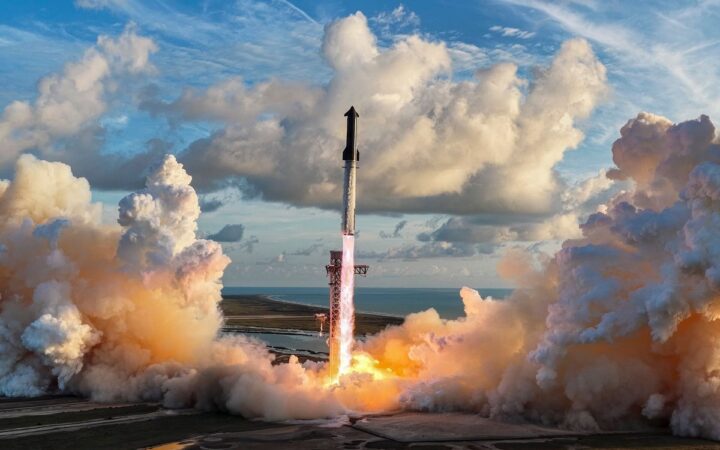
Jonas identified a potential Starship catch during Flight 15 as a major upcoming catalyst. The report placed the expected mission in late October or early November. That timing and the proposed catch remain expectations, rather than completed events.
The $300 target is an analyst forecast, not company guidance. Its relevance rests on the operational and commercial progress assumed in the bank’s assessment, including whether more capable launch systems can support a much larger satellite and infrastructure business.
MarketSpeaker’s earlier Citi analysis explored a separate long-term valuation scenario following Starship’s first orbital flight. Such scenarios show how strongly Wall Street’s estimates depend on future scale, rather than describing revenue or profit already earned.
Starlink Provides the Largest Revenue Base
SpaceX’s August 4 earnings update reported second-quarter revenue of $7.81 billion, up 92% from a year earlier, and a net loss of $541 million. The results cover the quarter ended June 30.
Connectivity, which includes Starlink, contributed $4.29 billion, making it the largest revenue segment. AI generated $2.56 billion, while the Space business produced $962 million. The mix shows that the listed company’s financial exposure extends well beyond selling rocket launches.
Connectivity also generated $1.66 billion of operating income, while AI posted a $1.26 billion operating loss. That contrasts the established subscriber business with a computing operation still absorbing substantial investment.
Starlink’s subscriber count reached 12 million, twice the year-earlier figure. The quarterly filing also showed monthly average revenue per subscriber at $66, down from $85 a year earlier. Subscriber growth and revenue per customer therefore need to be considered together when assessing the network’s commercial progress.
Expansion carries substantial costs. SpaceX reported $18.37 billion of second-quarter capital expenditure, including $15.83 billion in AI. It ended the quarter with about $100 billion in cash, cash equivalents and marketable securities. Those resources provide investment capacity, while the spending underscores how much infrastructure must be financed before future returns are realized.
Starship Progress Brings Execution Into Focus
SpaceX’s September 28 mission update confirmed that Flight 14 reached orbit and deployed 26 Starlink V3 satellites. Contact was established with all of them, with checkouts and orbit-raising required before customer service begins.
The flight also exposed remaining reliability work. A vacuum engine shut down early during ascent, and controllers shortened the orbital phase as a precaution before bringing Starship to a Pacific splashdown. Successful payload delivery advanced the program, while routine recovery and rapid reuse remain important tests.
SpaceX is also supplying launch services for experimental computing infrastructure. MarketSpeaker’s orbital computing coverage examines Google’s processor tests and the unresolved economics of larger space-based systems.
Monday’s rally shows investors assigning more value to that combination of recurring connectivity revenue and future launch and AI opportunities. The next evidence will come from mission performance, customer growth and financial disclosures showing how efficiently SpaceX can turn its extensive investment into durable earnings.