Key Notes
- Citi links Starship’s progress to a possible $12.2 trillion SpaceX valuation, contingent on a much larger commercial business.
- SpaceX deployed 26 Starlink V3 satellites during Flight 14, but an engine issue prompted an earlier return to Earth.
- The financial payoff depends on reliable launches, lower operating costs and demand that turns added satellite capacity into profitable growth.
Citi sees SpaceX’s first orbital Starship flight as a step toward a possible $12.2 trillion valuation, linking the rocket’s progress to the company’s ability to build much larger satellite communications and space infrastructure businesses.
Analysts led by John Godyn outlined the long-term scenario following the September 28 mission, MarketWatch reported. The estimate implies a share price of $900 or more and remains conditional on SpaceX turning its engineering achievements into sustained commercial expansion.
Starship Reaches Orbit, but Testing Continues
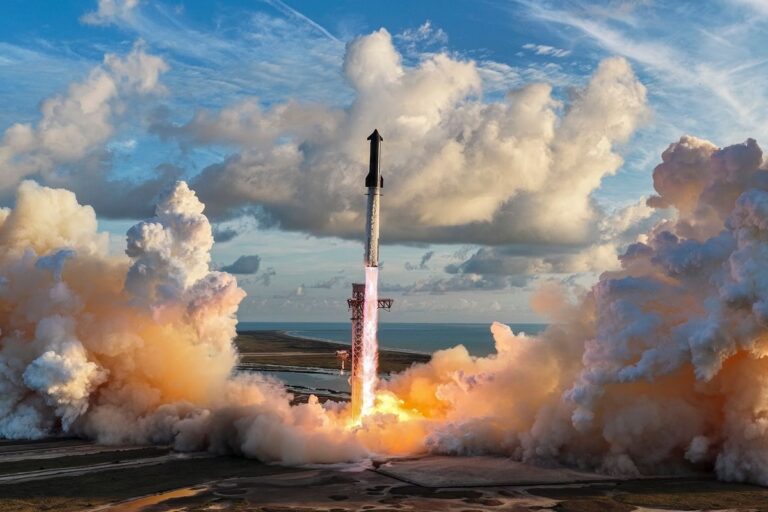
SpaceX’s mission update confirms that Flight 14 reached orbit and deployed 26 Starlink V3 satellites. The company established contact with every satellite, which must complete checkouts and raise their orbits before serving customers.
The flight also exposed remaining technical challenges. A vacuum engine on Starship shut down early during ascent, and the spacecraft compensated by running its remaining engines longer. Controllers subsequently approved an orbital insertion burn after assessing the engines needed for later maneuvers.
SpaceX then shortened the orbital portion of the mission as a precaution, bringing Starship back to a designated splashdown area in the northern Pacific. The result demonstrated payload delivery and orbital operations, while leaving reliability and routine reuse as further tests for the program.
Launch Capacity Has a Direct Commercial Role
The financial significance extends beyond selling rocket launches. SpaceX operates both the transportation system and the satellite network it supplies, giving improvements in launch capacity a potential effect on the economics of its communications business.
Starlink says its V3 satellites are designed for 1 terabit per second of downlink capacity, approximately 10x the capacity of the previous V2 design. That is total satellite capacity, rather than a promised download speed for an individual customer.
More capacity could support additional subscribers and business customers. The commercial benefit, however, depends on demand, pricing and the cost of building, launching and operating the network. Deploying more satellites does not by itself establish how much profit their capacity will generate.
MarketSpeaker has previously covered SpaceX’s plans for mobile services, illustrating the company’s ambitions to reach further into telecommunications. Those opportunities make launch efficiency relevant to competition and recurring revenue, as well as to the space industry.
A Long-Term Scenario With Demanding Assumptions
The $900-plus scenario is separate from Citi’s $200 year-end share-price target. Benzinga’s account of the research also describes projections of $484 billion in revenue and $360 billion in earnings before interest, taxes, depreciation and amortization by 2030.
Those are analyst forecasts, not SpaceX’s reported results. The distinction matters because EBITDA does not deduct capital expenditure and therefore cannot be treated as cash available after paying for rockets, satellites and computing infrastructure.
A valuation ultimately depends on the cash a business can generate over time. Manufacturing costs, replacement spending and the pace of customer adoption all affect how much of an expanding revenue base can become cash flow for investors.
Commercial Scale Remains the Next Test
The importance of execution was evident before the latest launch. In its June 9 pre-IPO analysis, Morningstar identified rapid Starship reuse and commercially competitive orbital AI data centers as pivotal uncertainties in SpaceX’s valuation.
That research also described Starlink as the business expected to provide much of the cash for further expansion. The relationship creates a financing challenge: established operations must support investment in technologies whose commercial returns remain uncertain.
For investors, the next evidence will need to go beyond another successful launch. Repeatable missions, reliable payload deployment, faster vehicle turnaround and measurable operating economics will help determine how much value the system can support. Flight 14 advanced the technical case; the financial case still depends on scaling it profitably.