Meta has unveiled a radically lighter approach to virtual reality with its new Meta VR Glasses, a $1,299 device designed to deliver many of the immersive computing capabilities associated with Quest and Apple’s Vision Pro without requiring users to wear a bulky computer on their face.
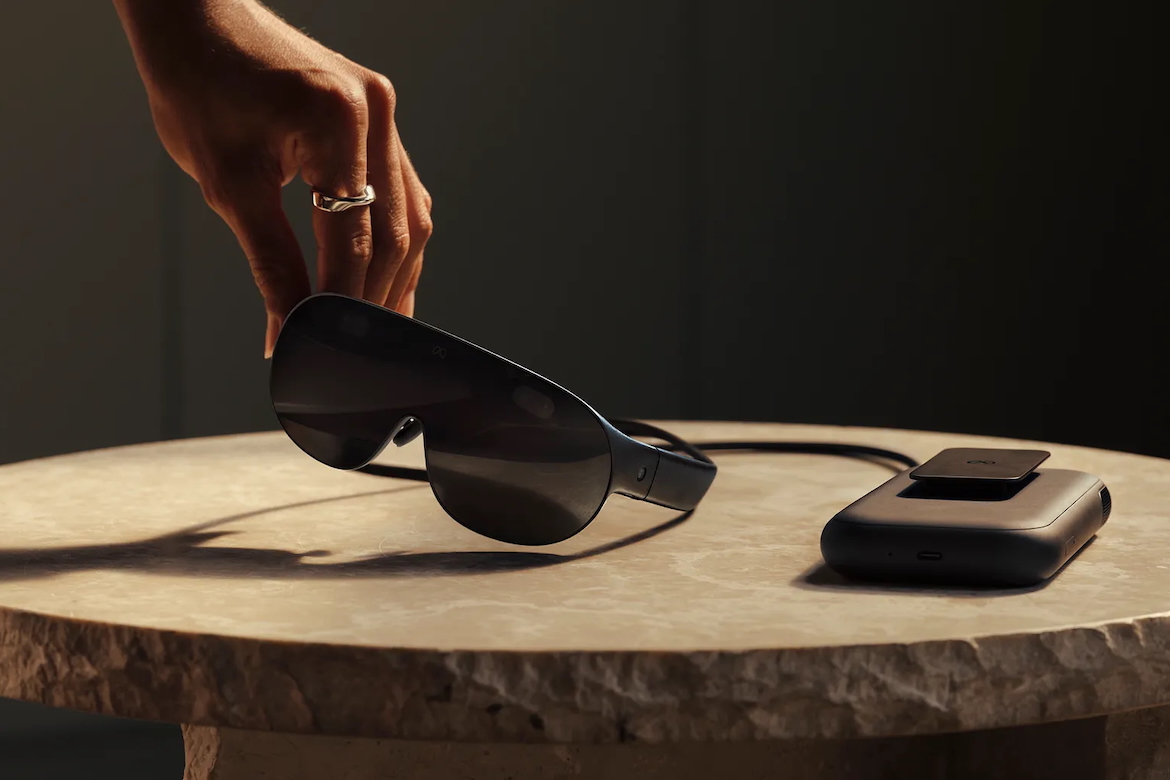
Introduced by CEO Mark Zuckerberg at Meta Connect, the glasses weigh approximately 100 grams, roughly one-fifth the weight of Meta’s Quest 3. The dramatic reduction comes from splitting the device into two components: the glasses contain the displays, optics, cameras and sensors, while the processor, battery and storage are moved into an external module connected by cable that can be carried in a pocket.
Meta Moves the Computer Off Your Face
The external module is central to Meta’s design. Instead of attempting to fit high-performance computing hardware and a large battery directly into the headset, the company has moved those components into a separate unit weighing about 300 grams.
That leaves only around 100 grams resting on the user’s face. By comparison, Apple’s Vision Pro is a substantially heavier self-contained headset, while Meta says its new glasses are five times lighter than Quest 3.
The tradeoff is that users remain physically tethered to the compute module. But Meta is betting that carrying the heavier components in a pocket will prove considerably more comfortable than supporting their weight on the head during long movies, work sessions or games.
Meta describes the product as a combination of a personal cinema, workspace, gaming console and virtual courtside seat.
5K Display and Gesture Controls
The glasses feature Meta’s new 5K Infinite Display, using micro-OLED technology and delivering 37 pixels per degree. They also support spatial computing applications that allow users to position multiple virtual screens around their environment and connect to a Mac or PC for work.
Interaction is built primarily around eye tracking and hand gestures. Users can look at interface elements and control them with their hands rather than relying on traditional controllers. Meta says more than 75 games will support gesture-only interaction at launch, while Quest controllers and Xbox controllers can still be used for compatible games.
The device also retains access to the broader Quest software ecosystem, giving Meta an existing content library when the hardware arrives rather than forcing it to build a new platform from scratch.
Meta Takes Another Shot at Vision Pro
The positioning inevitably puts the new product against Apple’s Vision Pro. Both devices target immersive entertainment and spatial computing, but Meta is pursuing a fundamentally different hardware architecture.
Apple concentrated most of Vision Pro’s computing hardware inside the headset while using an external battery. Meta has gone further by moving the processor, storage and battery away from the user’s head.
That engineering decision allows Meta to reach the 100-gram weight target while pricing the product at $1,299.99, significantly below the price associated with Apple’s premium spatial-computing headset. Fortune described Meta’s announcement as a direct escalation of its hardware competition with Apple.
The comparison is not entirely direct, however. Vision Pro remains a largely self-contained computer, whereas Meta VR Glasses depend on their tethered external module. Their different architectures reflect different compromises between portability, performance and weight.
Meta Bets That VR Needs to Get Lighter
Zuckerberg acknowledged during the announcement that many consumers simply do not want to wear conventional headsets. Meta therefore reduced its focus on releasing more VR hardware unless it could deliver what the CEO characterized as meaningful technological breakthroughs.
The 100-gram design is the company’s answer to that problem.
Meta VR Glasses will go on sale in spring 2027 for $1,299.99, with availability planned across North America, Europe and Asia.
The result looks less like another incremental Quest update and more like an attempt to redefine the physical form of high-end VR. Instead of making the computer on the user’s face slightly smaller, Meta has effectively removed much of that computer from the headset altogether.
If consumers accept carrying a tethered compute module in exchange for dramatically lighter glasses, Meta’s design could point toward a different path for spatial computing – one where the most important specification is no longer how powerful the computer on your face can become, but how much of it can be moved somewhere else.