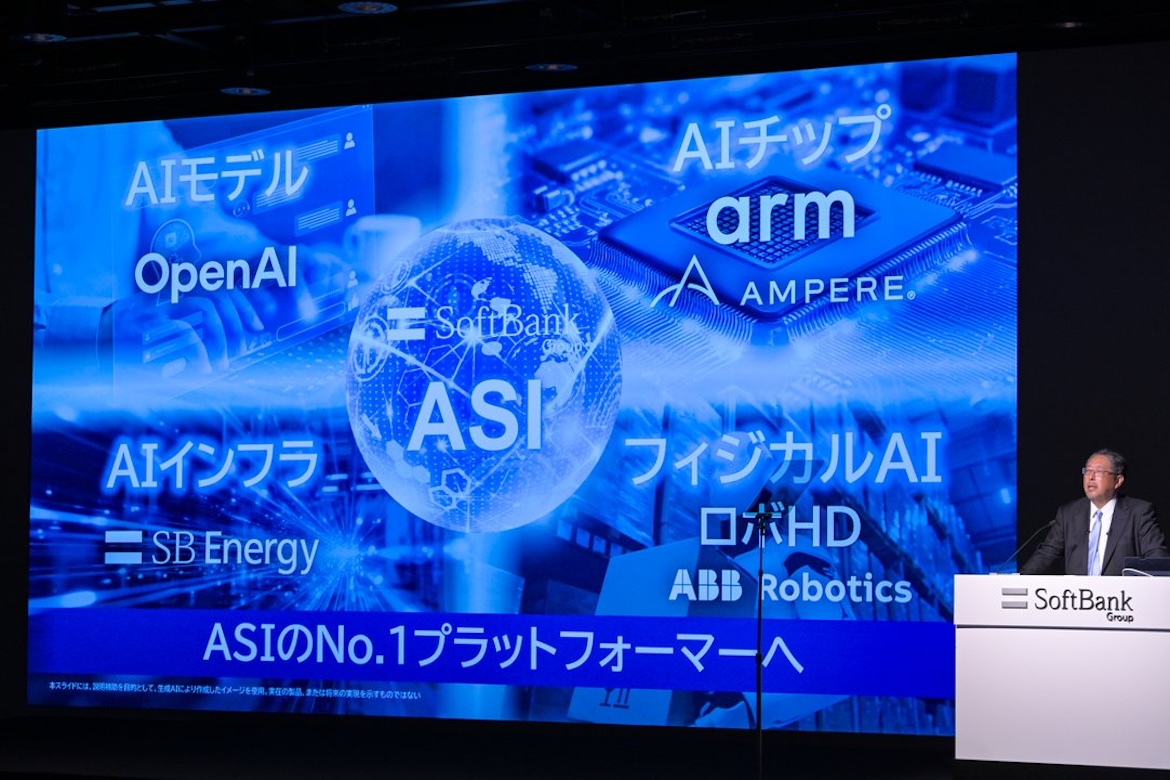
SoftBank Group has launched one of its largest bond offerings as the Japanese technology investor raises more than $11 billion to finance its expanding investment in OpenAI.
The company is marketing $10 billion of U.S. dollar-denominated senior unsecured notes alongside €1 billion, or roughly $1.15 billion, of euro-denominated bonds, according to a term sheet reviewed by Reuters. Most of the proceeds are expected to finance a $10 billion payment representing the third tranche of SoftBank’s follow-on investment in OpenAI, with the transaction scheduled to close on October 1. Remaining proceeds can be used for general corporate purposes.
SoftBank Turns to Debt to Finance OpenAI Bet
The dollar portion of the offering is divided between maturities of 3.5 years, 5.5 years and 7.5 years, while the euro bonds will mature in four and six years. The securities are expected to be priced on September 24 and settle on September 29.
SoftBank had previously secured a $10 billion bridge loan facility to finance the OpenAI investment. According to the term sheet, proceeds from the new bond offering will effectively replace that temporary financing, allowing the group to move the obligation into longer-term debt.
Citigroup and JPMorgan are serving as lead bookrunners for the offering. The scale of the transaction highlights SoftBank’s willingness to use its balance sheet and access to global capital markets to increase its exposure to artificial intelligence.
Masayoshi Son Doubles Down on Artificial Intelligence
OpenAI has become central to SoftBank founder Masayoshi Son’s strategy as he attempts to position the group at the center of the next generation of AI infrastructure and technology.
The investment comes at a time when frontier AI development is becoming extraordinarily capital intensive. OpenAI expects hundreds of billions of dollars in spending on computing capacity and infrastructure through the end of the decade as it builds larger data centers and trains increasingly powerful models.
That spending creates enormous financing requirements not only for OpenAI but also for the investors and technology companies supporting its expansion. SoftBank’s latest bond sale illustrates how the AI investment cycle is increasingly reaching beyond venture capital and equity markets into global corporate debt.
The financing also demonstrates the concentration of SoftBank’s strategy around AI. Son has repeatedly described artificial intelligence as the defining investment opportunity of the coming decades, and the group has been restructuring its portfolio around companies expected to benefit from rising demand for computing infrastructure.
SoftBank Takes on More Financial Exposure
The strategy could deliver substantial upside if OpenAI continues its rapid commercial expansion, but financing investments through debt also increases SoftBank’s exposure if valuations across the AI sector decline or capital becomes more expensive.
The company’s ability to raise more than $11 billion in a single transaction therefore represents an important test of investor appetite for debt tied indirectly to the AI investment boom. The bonds themselves are obligations of SoftBank rather than OpenAI, meaning bondholders are ultimately taking credit exposure to the Japanese investment group.
SoftBank’s decision to replace short-term bridge financing with longer-maturity bonds should provide greater certainty around funding for its OpenAI commitment. At the same time, it locks in a significant financial obligation as competition among AI developers continues to drive infrastructure spending higher.
AI Boom Spreads Into Global Debt Markets
The transaction represents another sign that the artificial intelligence investment cycle is becoming deeply connected to global capital markets.
AI companies and their partners require enormous amounts of capital for semiconductors, data centers, electricity and networking equipment. As those requirements grow, financing is increasingly coming from a combination of equity, private credit, bank loans and corporate bonds rather than traditional venture funding alone.
For SoftBank, the new bond sale provides the capital needed to complete another major step in its OpenAI investment strategy. For financial markets, it demonstrates the scale of funding now required to support the world’s largest AI companies.
With more than $11 billion being raised largely to finance a single investment, SoftBank is making clear that its commitment to OpenAI is no longer simply another portfolio position. It has become one of the defining bets on the group’s balance sheet.