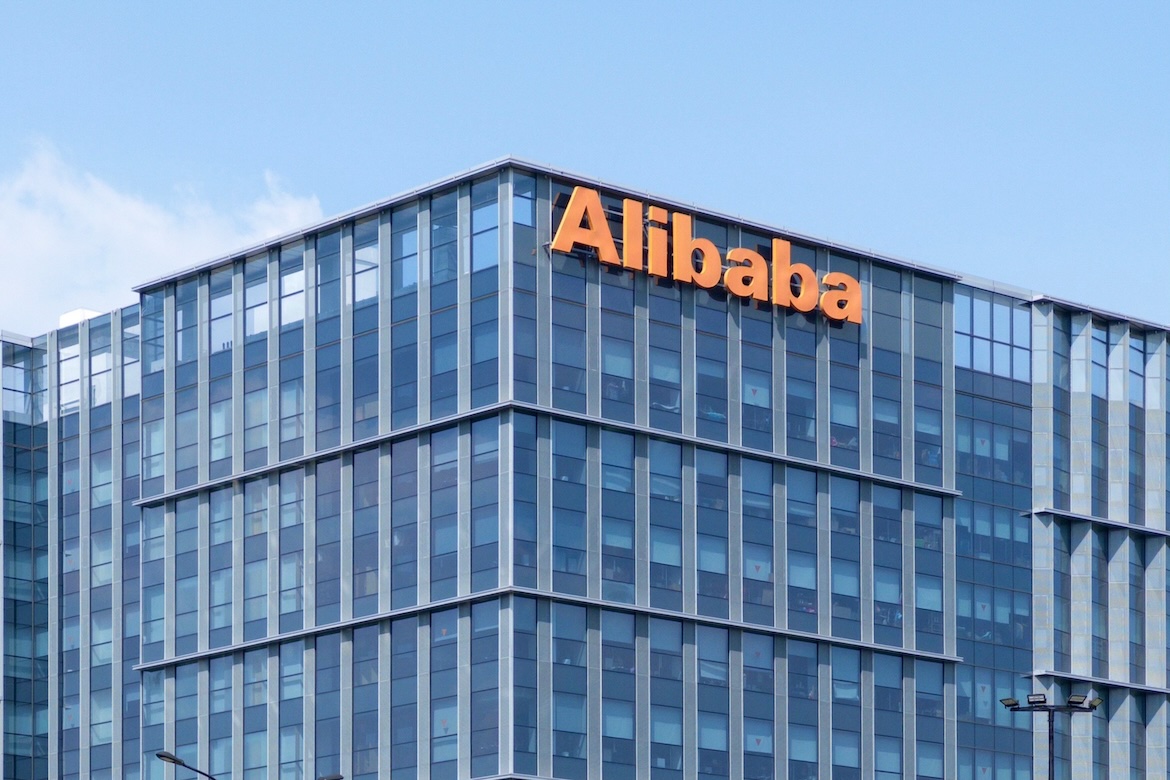
Alibaba is dramatically expanding its artificial intelligence ambitions, unveiling a new domestic AI accelerator while laying out plans for models containing as many as 10 trillion parameters and more than 20 gigawatts of global data center capacity by 2032.
At its annual Apsara Conference in Hangzhou, Alibaba introduced the Zhenwu V900, a next-generation accelerator developed by its T-Head semiconductor division. CEO Eddie Wu said the chip delivers three times the performance of its M890 predecessor and can operate in clusters containing as many as 500,000 chips, providing the computing power needed to train and run increasingly large AI models.
Zhenwu V900 Targets Nvidia’s AI Dominance
Alibaba plans to begin mass production and commercial availability of the Zhenwu V900 in the first quarter of 2027. The company expects annual shipments of its AI chips to increase significantly as demand for domestic computing infrastructure accelerates across China.
The launch comes as Chinese technology companies race to develop alternatives to Nvidia’s accelerators amid U.S. restrictions on exports of advanced AI chips to China. Alibaba described the Zhenwu V900 as China’s most powerful AI chip, although that characterization comes from the company itself.
Alibaba is increasingly pursuing a vertically integrated strategy encompassing semiconductors, foundation models, cloud infrastructure and data centers. Rather than depending entirely on external chip suppliers, the company wants its own hardware to provide a larger portion of the computing capacity behind Qwen and Alibaba Cloud.
Investors responded positively to the announcement. Alibaba’s Hong Kong-listed shares jumped 5.1% to their highest level in a month following the presentation.
Qwen Models Could Reach 10 Trillion Parameters
Alibaba is simultaneously preparing a major increase in the scale of its AI models. Wu said the Qwen team plans to train future systems containing between 5 trillion and 10 trillion parameters, designed to handle more complicated tasks requiring substantially longer periods of reasoning and execution.
Alibaba’s current flagship, Qwen 3.8 Max, contains 2.4 trillion parameters. The company said Qwen 4 is already being trained, while future Qwen 4.5 and Qwen 5 models are expected to scale toward the 5-trillion-to-10-trillion parameter range.
The company is also working on systems capable of improving themselves with less human intervention. According to Wu, Alibaba researchers have made progress in enabling models to identify their own weaknesses, design experiments and generate training data as part of an iterative improvement process.
Larger parameter counts alone do not necessarily translate into better AI performance. Architecture, training data, inference techniques and computational efficiency are also critical. But Alibaba’s plans illustrate the extraordinary scale of computing infrastructure it believes will be required for the next generation of frontier models.
Alibaba Cloud Targets More Than 20GW
Supporting those models will require an enormous expansion of Alibaba’s physical infrastructure. Wu set a target for Alibaba Cloud’s global data center capacity to exceed 20 gigawatts by 2032, citing rapidly increasing customer demand for artificial intelligence.
Alibaba has already committed more than $53 billion over three years to expand its AI capabilities, while raising roughly $10.2 billion through a Hong Kong follow-on share offering in August. The company plans to begin bringing AI supernodes online commercially this quarter as it increases available computing capacity.
Supply remains a major constraint. Wu said medium- and long-term industry demand is running far ahead of available supply, highlighting the challenge facing technology companies attempting to build AI infrastructure at unprecedented scale.
Alibaba Builds Its Own AI Ecosystem
The announcements demonstrate how Alibaba is attempting to compete across virtually every layer of the AI industry. Zhenwu provides proprietary computing hardware, Qwen supplies the foundation models, and Alibaba Cloud provides the data centers required to train and deploy them.
That strategy could become increasingly important as access to advanced U.S. semiconductors remains constrained. Developing competitive domestic accelerators would give Alibaba greater control over its computing supply while potentially reducing dependence on Nvidia.
The scale of the company’s ambitions is also growing rapidly. A chip with three times the performance of its predecessor, AI clusters containing hundreds of thousands of accelerators, models approaching 10 trillion parameters and more than 20 gigawatts of data center capacity all point toward the same objective: building an integrated Chinese AI platform capable of competing with the world’s largest technology companies.
For investors, Alibaba is increasingly becoming more than an e-commerce and cloud company. Its latest roadmap represents a multiyear bet that semiconductors, frontier models and massive computing infrastructure will become the foundations of its next stage of growth.