Key Notes
- The Nasdaq drops more than 3% during United States trading after major indexes in Asia and Turkey finish lower, extending a global retreat from risk.
- Gold futures fall below $3,900 and silver remains below $50, while CoinGecko data shows a sharp 24-hour decline in crypto market value.
- Treasury yields fall as government bonds rally, and the verified snapshots do not establish a combined $3 trillion daily loss across asset classes.
Global markets suffered a broad selloff on Friday, October 30, as investors cut exposure to technology stocks, precious metals and cryptocurrencies. The Nasdaq Composite dropped more than 3% during U.S. trading, while gold broke below $3,900 an ounce and silver extended its retreat below $50.
The declines followed losses across major Asian equity markets and Turkey, with disappointing technology-company outlooks and the financing burden of artificial intelligence investment weighing on sentiment. U.S. Treasury bonds moved in the opposite direction: benchmark yields fell, showing demand for government debt rather than a simultaneous selloff in every major asset class.
Wall Street’s Tech Selloff Intensifies
The Nasdaq Composite traded at 25,324.81, down 3.28%, in a Yahoo Finance snapshot at 17:52 UTC. The S&P 500 was down 2.04% at 7,563.24, while the Dow Jones Industrial Average fell 1.06% to 51,785.80 in readings taken within the same minute. These were intraday prices, with the U.S. session still open.
Technology shares remained the pressure point. As we reported, results from Amazon.com Inc. (NASDAQ: AMZN) and a weak fourth-quarter outlook from Intel Corp. (NASDAQ: INTC) sharpened scrutiny of spending, cash generation and demand.
Amazon has maintained its $220 billion capital-expenditure forecast for 2026, while its negative $42.4 billion free-cash-flow figure covers the trailing 12 months. That distinction matters: it is not a $42.4 billion quarterly outflow. Intel’s guidance added concerns about the PC market alongside the broader debate over returns on AI infrastructure.
The selling was not uniform. CNBC’s live coverage showed gains in consumer staples and health care as investors moved toward more defensive businesses. Our earlier update tracked that rotation before the major indexes extended their losses.
Asian Markets and Turkey Close Lower
The weakness stretched beyond Wall Street. Yahoo Finance’s closing quotes showed declines in Japan, South Korea, Taiwan and mainland China, markets with different exposures to global manufacturing, semiconductors and domestic demand.
- Japan’s Nikkei 225 fell 2.12% to 63,290.11.
- South Korea’s Kospi dropped 3.48% to 5,730.74.
- Taiwan’s Taiex declined 2.49% to 45,211.83.
- China’s Shanghai Composite lost 1.44% to 3,599.02.
- Turkey’s BIST 100 closed down 3.64% at 10,759.56.
These are completed local sessions, rather than prices recorded simultaneously with the U.S. snapshot. Their combined direction illustrates the breadth of the retreat, but the index percentages alone do not establish a dollar loss across all the companies listed in those markets.
The latest declines also follow the Chinese AI rout we previously covered. The connection is investors’ reassessment of expensive technology exposure; each market also has its own earnings, policy and currency influences.
Gold and Silver Fall Alongside Stocks
Precious metals offered little shelter during the selloff. December COMEX gold futures traded at $3,892.20 an ounce, down 3.45%, in a delayed Yahoo Finance quote at 17:39 UTC. December silver futures were at $49.215, down 6.04%, at 17:41 UTC.
Spot and futures prices should be distinguished. Kitco’s spot quote showed a gold bid of $3,880 and an ask of $3,882 at 17:51 UTC, with the bid down 3.49%. Those prices describe immediate-delivery bullion, while the COMEX figures refer to December contracts.
We previously reported gold’s break below $4,000 and tracked silver’s fall below $50. Persistent inflation and uncertainty over future interest rates remain part of the backdrop for metals, even as Treasury yields eased during Friday’s trading.
Binance Hack Adds Pressure to Crypto
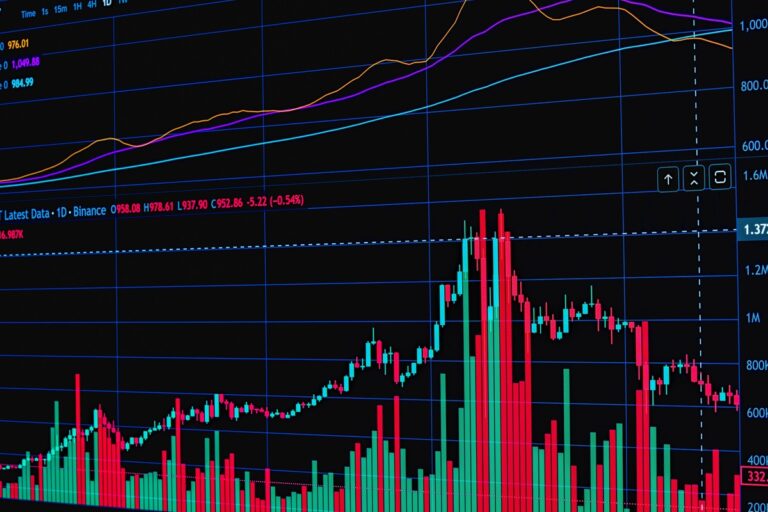
Bitcoin traded near $77,023 in a Yahoo Finance reading at 17:52 UTC, with the provider displaying a 4.67% decline. The cryptocurrency market faced an additional shock from the multibillion-dollar Binance hack and the exchange’s withdrawal suspension.
CoinGecko’s global data put total crypto market capitalization at approximately $2.616 trillion, down 6.94% over the preceding 24 hours, as of 17:53 UTC. Calculating the prior value from those figures implies a decline of about $195 billion. That rolling 24-hour measure is distinct from the stock market’s Friday session.
Binance co-CEO Richard Teng has said the exchange aims to restore withdrawals within 40 hours of his Friday address, subject to security testing. The exchange’s stated funding allocation and promised reserve report do not mean the recovery is already complete.
Treasuries Rally as Investors Reduce Risk
The bond market complicates the picture of an across-the-board liquidation. CNBC’s Tradeweb quote showed the 10-year Treasury yield at 4.935% at 17:51 UTC, down from a previous close of 4.989%. The 30-year yield was 5.311% at 17:52 UTC, compared with 5.329% previously.
Those moves represent declines of 5.4 and 1.8 basis points, respectively. Treasury prices rise when yields fall, so the readings indicate a government-bond rally during the equity and metals retreat.
The session therefore reflects both falling risk appetite and a rotation between assets. Market-value changes are also different from realized investor losses. Adding stock, metal and crypto estimates into one global total requires consistent valuation methods, nonoverlapping holdings and matching time windows; the verified price snapshots do not establish a single $3 trillion daily loss.