Key Notes
- SK hynix closed 10.09% lower and Samsung lost 7.39%, while the KOSPI recovered from its intraday low to finish down 5.46%.
- Selling spread to Japanese and European technology shares, with American memory stocks also lower in premarket trading.
- CXMT’s server-memory plans and AI funding requirements remain distinct risks, with production scale and project financing still to be demonstrated.
SK hynix Inc. (KRX: 000660) plunged 10.09% on October 13 as a selloff in memory and AI-related stocks spread across Asian and European markets. Investors weighed advances by China’s ChangXin Memory Technologies, or CXMT, against concerns about the financing needed to sustain the AI infrastructure boom.
Samsung Electronics Co. Ltd. (KRX: 005930) closed 7.39% lower, while South Korea’s KOSPI lost 5.46% to 6,035.35, Yonhap reported. Foreign investors sold a net ₩4.51 trillion of Korean shares, extending the benchmark’s losing streak to five sessions.
The weakness reached Japan’s SoftBank Group Corp. (TSE: 9984) and Europe’s ASML Holding NV (AMS: ASML), with U.S. memory stocks also lower before the open, according to CNBC’s report. The cross-market retreat put both semiconductor competition and the wider economics of AI investment in focus.
Korean Closing Losses Follow a Deeper Intraday Drop
The KOSPI had fallen roughly 7.4% during the session, as we reported earlier. Its smaller closing decline reflects a partial recovery from that low, rather than a different trading day or a reversal of the overall selloff.
Samsung finished at ₩232,000 and SK hynix at ₩1.44 million, according to Yonhap. Institutions bought a net ₩1.69 trillion of Korean shares and individuals purchased ₩2.23 trillion, partially countering foreign selling.
The exchange also activated a sell-side sidecar during the morning. That measure temporarily restricts program-selling orders after a sharp futures move; it should not be confused with a complete halt in stock-market trading. Our earlier report explains the trigger and the separate Korean crypto developments.
SoftBank and European Chip Stocks Join the Retreat
CNBC reported SoftBank down 8.5% and Tokyo Electron Ltd. (TSE: 8035) down 7.2% in Japan. In early European trading, ASML fell 3.3%, while STMicroelectronics NV (EPA: STMPA) and Infineon Technologies AG (XETRA: IFX) were each around 5% lower. Micron Technology Inc. (NASDAQ: MU) was about 3% lower in U.S. premarket trading.
The European and U.S. figures are snapshots from CNBC’s report updated at 08:56 UTC, not closing returns. They also cover different local trading sessions, so they should not be combined into a single synchronized measure of market losses.
The breadth matters because the companies occupy different parts of the investment chain. Memory suppliers sell components, equipment makers enable chip production, and SoftBank provides exposure to AI businesses through investment holdings. Their shares can respond to a common change in expectations without facing identical commercial risks.
CXMT’s Server-Memory Plan Raises the Supply Question
CXMT president Cao Kanyu outlined progress on a 4F² DRAM architecture at an October 10 conference, according to Cailian Press. The company expects to introduce DDR5 registered server-memory modules incorporating the technology by the end of 2026.
The proposed architecture reduces the area occupied by each memory cell relative to the mainstream 6F² approach, potentially allowing more data to be stored in the same chip area. The report said Cao did not disclose detailed product specifications or a precise launch date.
For investors, additional competitive supply could eventually affect pricing and margins. But a development announcement does not establish manufacturing yields, customer qualification or sustained high-volume shipments. Those steps determine whether a technical advance becomes a commercially significant alternative.
Server DRAM and High-Bandwidth Memory Have Different Tests
The announced DDR5 module should not be treated as proof that CXMT has matched the high-bandwidth memory used alongside advanced AI processors. HBM stacks multiple DRAM chips and places different demands on packaging, data transfer and integration.
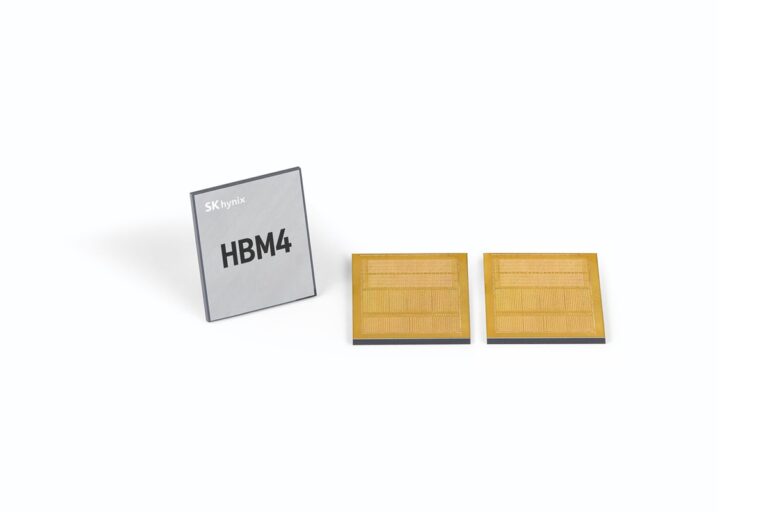
SK hynix’s September 2025 announcement provides a useful baseline: it said HBM4 development and preparations for mass production were complete, with 2,048 input-output terminals, twice the previous generation’s bandwidth and more than 40% better power efficiency. Those are company specifications, rather than an independent comparison with CXMT.
The International Energy Agency’s 2026 assessment also identifies a shortage of high-bandwidth memory that it expects to persist through at least the end of 2027. That forecast underlines why competition in conventional server DRAM and availability of advanced HBM need to be assessed separately.
AI Financing Adds Another Source of Pressure
Capital availability is the other concern surrounding the sector. The chief executives of Intel Corp. (NASDAQ: INTC) and Broadcom Inc. (NASDAQ: AVGO) warned that financing could become a bottleneck for the infrastructure buildout, as we previously reported. Their remarks described a risk to expansion, rather than announcements that customers had canceled their projects.
The IEA estimates that capital expenditure by the largest technology companies exceeded $400 billion in 2025 and would rise another 75% in 2026. The latter is an estimate, not a completed spending total. It argues that data-center investment has grown too large to rely on corporate balance sheets alone.
That links the semiconductor outlook to access to capital markets and expectations for returns. Strong demand for computing can coexist with uncertainty over which projects secure funding, how quickly equipment is deployed and when customers generate enough revenue to cover their costs.
The next evidence investors can assess is concrete: CXMT’s product specifications and shipment progress, incumbent suppliers’ orders and margins, and the funding commitments behind AI construction. Tuesday’s selloff shows a sharp reassessment of risk; it does not by itself settle those longer-term questions.