Key Notes
- Morgan Stanley now expects tokenized-equities support in the first quarter of 2027.
- Product availability and institutional readiness remain central to the revised timetable.
- Trading infrastructure must connect with settlement systems and clearly defined investor rights.
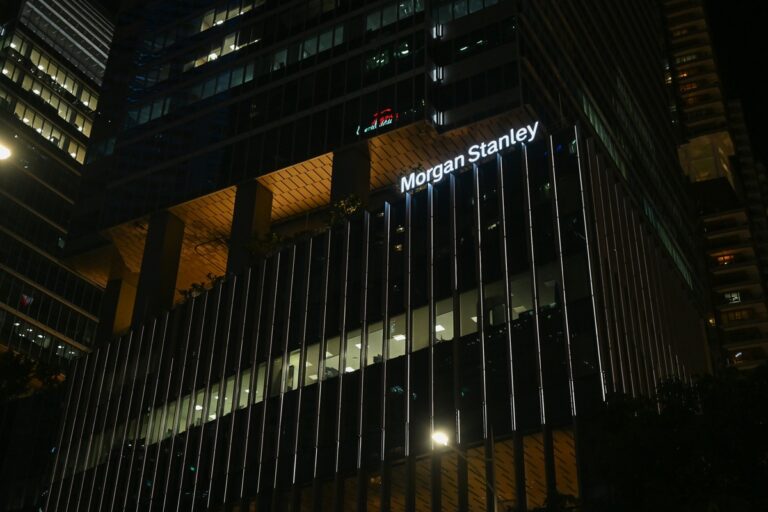
Morgan Stanley (NYSE: MS) expects to support tokenized equities on its alternative trading system in the first quarter of 2027, moving beyond an earlier target of the second half of 2026.
Amy Oldenburg, the bank’s head of digital asset strategy, outlined the revised window in an exclusive interview with The Block, which reported her comments on October 12. She described Q1 as a more realistic timetable while the bank builds infrastructure and waits for the market to develop.
Oldenburg cited limited product availability as a constraint on institutional demand. The timetable is an expectation, rather than confirmation that trading has begun or a fixed launch date for customers.
A New Asset Format for an Existing Trading Business
The plan brings tokenized securities into the business of matching investment orders. An alternative trading system provides a venue outside a public stock exchange; using blockchain records changes how a security can be represented and transferred, without eliminating the need for an execution venue.
Morgan Stanley already operates several such systems. Its public disclosures describe MS Trajectory Cross as a dark pool that matches orders handled by certain bank algorithms over defined time intervals. Executions receive volume-weighted average pricing for the relevant interval.
Those disclosures describe existing trading infrastructure, rather than specifications for the planned tokenized-equities service. They should not be read as establishing its future stock lineup, client eligibility or trading hours.
The distinction is commercially important. A bank can develop a way to execute transactions before enough eligible securities and participating investors exist to create a substantial market. The eventual business will depend on both the trading technology and the assets available to use it.
DTCC Is Building the Settlement Infrastructure
The broader market has already moved beyond demonstrations alone. The Depository Trust & Clearing Corporation announced on July 15 that securities held at its Depository Trust Company subsidiary had been converted into tokens and used in live production trades involving more than 30 firms.
The transactions covered several functions, including equity trades, securities lending, collateral pledges and Treasury repurchase activity. DTCC said the event prepared the way for a broader tokenization-service launch in October 2026.
Under DTCC’s model, securities held at DTC can be converted between conventional and tokenized forms. The organization says the tokenized assets retain the investor protections, ownership rights and entitlements associated with the underlying securities.
That infrastructure addresses a different task from an ATS: a trading venue matches transactions, while post-trade systems support the movement and recording of the assets. Progress in one layer does not by itself establish that every other part of a proposed service is ready.
Banks See an Opportunity in Capital Mobility
Morgan Stanley’s own roundtable, recorded on July 29 and published on September 30, explains the financial rationale behind the buildout. Betsy Graseck, its global head of banks and diversified finance research, identified cash mobility, collateral efficiency and new investment opportunities as reasons institutions are examining tokenization.
Oldenburg also discussed the need to connect tokenized products with the digital cash used to settle transactions. Moving the asset onto a blockchain is only one component; the payment side and the surrounding operational workflow must function together.
The potential benefit for financial institutions is therefore broader than offering a different way to hold stocks. More flexible collateral movement could change how firms meet obligations and deploy assets. These remain potential efficiencies, rather than savings already demonstrated by Morgan Stanley’s planned equities service.
The bank’s Digital Asset Lab provides another part of that preparation, as we previously reported. It creates a separate environment for evaluating blockchain technologies before they are connected to wider systems or offered through commercial products.
Legal Rights Still Depend on the Security
Tokenization does not give every product the same legal characteristics. The SEC’s investor-education guidance distinguishes issuer-sponsored securities, custodial interests and synthetic instruments that reference another security.
An issuer-sponsored token can carry the rights of a conventional share of the same class. A custodial structure represents an interest through an intermediary, while a synthetic instrument may provide price exposure without a claim against the underlying company. The structure determines what the investor actually owns.
Bank capital rules also remain relevant. U.S. banking regulators clarified in March that eligible tokenized securities generally receive the same capital treatment as their conventional equivalents. Banks must still manage the risks and comply with applicable law.
Separately, the SEC’s September innovation exemption provides conditional relief for certain tokenized-stock venues and liquidity providers. It preserves anti-fraud rules and requires qualifying shares to retain dividend and voting rights. That framework is not evidence that Morgan Stanley’s proposed service has received a specific approval under it.
For investors assessing the bank’s plan, the next useful details will be the supported securities, access arrangements and settlement model. Those will show how the proposed service fits into ordinary financial-market activity and whether it can attract sustained trading volume.