Key Notes
- SK hynix shares rose 10.89% after third-quarter operating profit surged 632% to a record 83.33 trillion won.
- Long-term agreements with 14 customers cover more than half of the company’s production capacity for 2027 and 2028.
- The approximately 100 trillion won annual shareholder-return plan includes earlier buybacks, while half of a new 20 trillion won repurchase is intended for cancellation.
SK hynix Inc. (KRX: 000660) shares jumped 10.89% on October 28 after the memory-chip maker reported record third-quarter revenue and operating profit, alongside plans for approximately 100 trillion won in shareholder returns this year.
The company reported revenue of 104.62 trillion won and operating profit of 83.33 trillion won, increases of 328% and 632% respectively from a year earlier. Stronger demand for AI memory, higher product prices and expanding sales of premium server components supported the results.
The earnings provide a fresh test of the investment case for SK hynix after a volatile month for semiconductor shares. They show substantial operating growth, although net profit declined from the previous quarter and the company’s forecasts still depend on customers sustaining their infrastructure spending.
Record Operating Profit Beats Market Estimates
Revenue exceeded the 98.34 trillion won LSEG SmartEstimate, while operating profit topped the 76.72 trillion won forecast, CNBC reported. Its report put the stock’s closing gain at 10.89%, ahead of the KOSPI’s 6.63% rise.
The improvement was substantial even against the previous quarter: revenue rose 32% and operating profit increased 38%. The operating margin reached about 80%, according to the company’s preliminary consolidated results.
Net income told a different sequential story. At 39.78 trillion won, it was 216% above the year-earlier level but 58% below the second quarter’s 93.92 trillion won. Record operating profit therefore should not be read as a record bottom-line result.
That distinction matters for shareholders assessing the quality of earnings. Operating profit measures the performance of the business before financing, investment-related items and tax, while net income reflects the wider set of gains and charges affecting the reported period.
HBM4 and Server Memory Drive the Product Mix
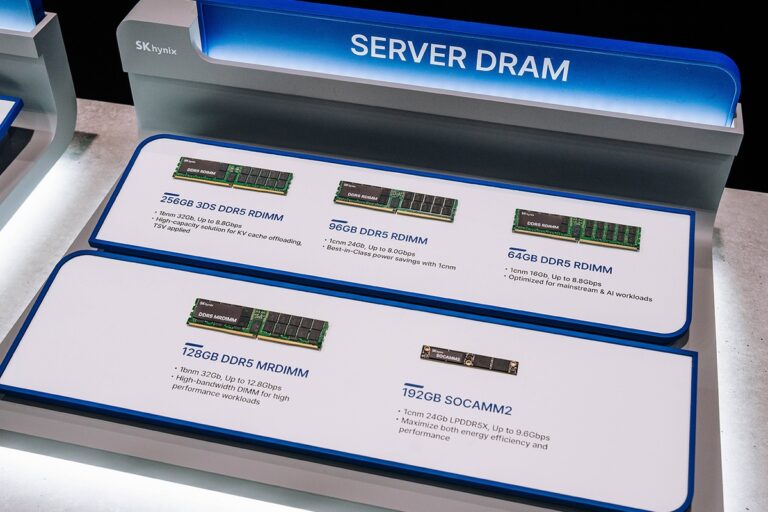
SK hynix said server DDR5 sales increased significantly as HBM4 shipments gathered pace. High-bandwidth memory places multiple memory layers in a stack to move large quantities of data alongside AI processors; HBM4 is the next generation now entering the company’s sales mix.
The chipmaker plans to bring its M15X facility to maximum capacity by year-end to expand HBM4 output. It expects HBM4 to overtake HBM3E in both shipment volume and revenue during the fourth quarter. That crossover remains a management forecast rather than a completed milestone.
Growth also extended to NAND flash storage. Sales of enterprise solid-state drives using 321-layer TLC technology expanded, while higher-value products for data centers contributed across the portfolio.
These developments connect the earnings story to several parts of AI infrastructure. Demand includes the memory feeding accelerators, conventional server memory and the storage needed to hold and retrieve data, rather than a single chip category.
Long-Term Contracts Support Capacity Expansion
SK hynix has signed long-term agreements with 14 major customers covering more than half of its production capacity for 2027 and 2028. The customers include large cloud-service providers, and the company is discussing longer terms with some buyers.
The agreements incorporate pricing mechanisms that respond to market conditions within agreed ranges. They improve visibility over contracted business, but should not be treated as a guarantee of unlimited pricing power or as proof that all future capacity has been sold.
Management expects demand to exceed memory supply through 2030, citing technical challenges and the time needed to build production facilities. The company also plans a significant increase in investment next year as Yongin’s first phase enters full-scale operation and infrastructure projects advance.
It said investment scale and timing would remain flexible, taking account of customer demand, competitiveness, profitability and efficiency. The central test is whether new capacity arrives in step with demand after the current period of tight supply.
Shareholder Returns Include Earlier Buybacks
The approximately 100 trillion won full-year return plan includes cash dividends of at least 30 trillion won and at least 60 trillion won of share repurchases and cancellations. It includes the 40 trillion won buyback announced in August and completed last week, rather than representing an entirely additional distribution.
The board approved a third-quarter cash dividend of 14 trillion won, or 20,000 won per share. Half the per-share payment reflects improved earnings, while the other half is a special dividend linked to gains on the company’s Kioxia investment.
It also approved a 20 trillion won repurchase. Shares worth 10 trillion won are intended for cancellation; approximately 10 trillion won will instead support employee compensation and are excluded from the shareholder-return total. Repurchases and cancellations therefore are not interchangeable measures.
At quarter-end, SK hynix reported 114.5 trillion won in cash and cash equivalents and 15.8 trillion won in borrowings, leaving 98.7 trillion won of net cash.
Strong Results Arrive After a Volatile Month
The rally follows the Korean chip selloff we previously reported, when investors weighed Chinese memory competition and the financing behind AI infrastructure. Strong current earnings do not settle those longer-term questions, but provide new operating evidence against which to assess them.
There was also a financing change within the group. CNBC reported that SK hynix had halted its review of potential pre-IPO fundraising and IPO options for U.S. subsidiary Solidigm, citing financial-market volatility and the semiconductor-stock correction.
For SK hynix investors, the next checkpoints are the HBM4 production ramp, delivery under long-term contracts and execution of the return plan. Those developments will help show how much of the present earnings strength carries into 2027.