Key Notes
- Royal Caribbean raised its full-year adjusted EPS forecast to $17.85–$17.95 after third-quarter adjusted earnings reached $6.57 per share.
- Revenue grew 9% to approximately $5.6 billion, supported by higher capacity and stronger late bookings in Europe and the Caribbean.
- Fuel and currency pressure partly offset the annual upgrade, while some third-quarter expenses shifted into Q4 rather than disappearing.
Royal Caribbean Group (NYSE: RCL) raised its full-year earnings forecast after stronger demand for late-booked cruises helped third-quarter results exceed its expectations, although higher fuel costs and currency movements limited the upgrade.
The cruise operator now expects 2026 adjusted earnings of $17.85 to $17.95 per share, compared with its previous range of $17.73 to $17.87. Its October 27 earnings release reported quarterly adjusted EPS of $6.57, up from $5.75 a year earlier.
For RCL investors, the update pairs resilient vacation demand with a more qualified cost picture: some expenses moved into the fourth quarter, while the company’s growing vacation portfolio will require continued investment.
Demand and Capacity Lift Quarterly Earnings
Revenue increased 9% to approximately $5.6 billion, while reported net income reached $1.7 billion, or $6.45 per diluted share. The adjusted earnings figure excludes certain items and should be distinguished from the company’s reported profit.
The company carried approximately 2.7 million guests as capacity increased 8%. Constant-currency net yields, a measure of revenue performance after selected variable costs relative to available capacity, rose 0.6%.
That distinction matters when reading the revenue growth. More available capacity supported the increase in sales; the yield measure captures a different part of performance and does not imply that cruise pricing rose at the same rate as total revenue.
Travel Weekly reported that demand for sailings booked close to departure was stronger than management had expected in July, particularly in the Caribbean and Europe. Those bookings helped improve the quarter after much of the sailing schedule had already been sold.
Operating Gains Support a Higher Forecast
The company’s investor presentation reconciles the updated annual outlook with its July forecast. It identifies $0.21 per share of third-quarter improvement excluding cost timing, offset by $0.11 of fourth-quarter fuel and foreign-exchange pressure.
The resulting midpoint rose from $17.80 to $17.90. The smaller annual increase compared with the quarterly earnings improvement shows how higher operating costs can absorb some of the benefit from stronger demand.
Some of the quarterly cost benefit was temporary. Constant-currency net cruise costs excluding fuel fell 1.8% per available passenger cruise day, partly because expenses shifted into Q4. Treating the entire decline as a lasting efficiency gain would overstate the improvement.
For the final quarter, management forecasts adjusted EPS of $3.48 to $3.58. Its presentation also projects constant-currency yield growth of 4.2% to 4.7%, alongside a decline in unit costs excluding fuel of 0.9% to 1.4%.
Fuel Remains an Important Offset
Royal Caribbean’s full-year fuel-expense assumption is approximately $1.345 billion. The fourth-quarter allowance is $379 million, based on current fuel prices and the effect of its hedging program.
The company says 58% of forecast Q4 fuel consumption is hedged through swaps. That provides partial protection, but does not eliminate exposure to changes in fuel costs.
The earnings bridge shows the effect on shareholders: stronger operating performance improved the outlook, while fuel and currency pressure absorbed part of that benefit. The relationship between booking strength and operating costs remains central to how much additional revenue reaches earnings.
Bookings Build for the Next Sailing Season
On the earnings call, management said booking volumes had increased in the mid-teens since the prior update, with bookings for 2027 sailings rising in the high teens. Those figures describe booking activity, rather than a forecast of next year’s revenue growth.
Chief Executive Jason Liberty also said close to half of this year’s guests were repeat customers. Returning customers and shorter intervals between cruises support the company’s effort to capture more vacation spending over time.
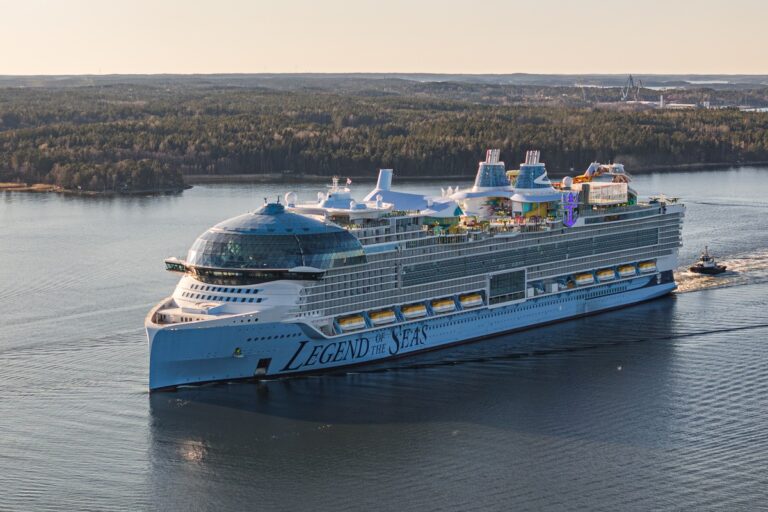
Royal Caribbean expects capacity to increase about 4.5% in 2027, according to its updated guidance. Travel Weekly highlighted the planned August debut of Hero of the Seas as part of that expansion.
The booking picture provides visibility into future demand, but the amount ultimately earned will also depend on pricing, sailing mix, costs and the delivery of new capacity.
Sandals Adds a New Investment Test
The broader strategy extends beyond cruises. As we previously reported, Royal Caribbean agreed to buy a 50% stake in Sandals and Beaches Resorts for approximately $3 billion, expanding into all-inclusive land vacations.
The transaction is expected to close in early 2027, subject to approvals and other closing conditions. It remains a pending investment rather than a completed acquisition contributing to the reported third quarter.
The company expects its share of the resort business to add to earnings after closing. For investors, that creates another operating opportunity, alongside the task of funding expansion and generating returns across a wider vacation portfolio.
Royal Caribbean said the expected resort contribution will be incorporated into its 2027 guidance upon closing. Until then, the raised 2026 forecast reflects the existing business, with the proposed resort investment remaining a separate step in its expansion.