Key Notes
- Groww has opened access to more than 10,000 US stocks and ETFs, including fractional shares, following a phased rollout.
- Zerodha’s competing service remains in beta and describes access to up to 2,000 stocks and around 1,000 ETFs through GIFT City.
- Groww’s $1 minimum brokerage per executed order and bank currency-conversion rates can materially affect the cost of small investments.
Indian retail investors are gaining easier access to U.S. equities as domestic brokerages expand their international offerings, bringing global technology stocks and exchange-traded funds into the same apps used to manage local investments.
Groww has opened U.S. stock investing to its users following a phased rollout, while Zerodha is testing a competing service. The expansion comes as demand for overseas exposure grows against a backdrop of weaker Indian equity performance and a depreciating rupee.
Companies including Nvidia (Nasdaq: NVDA), SpaceX (SPCX) and Apple (Nasdaq: AAPL) are among the popular early choices, Groww co-founder and Chief Operating Officer Harsh Jain told CNBC, which reported on the shift.
Groww Brings Global Stocks Into Its App
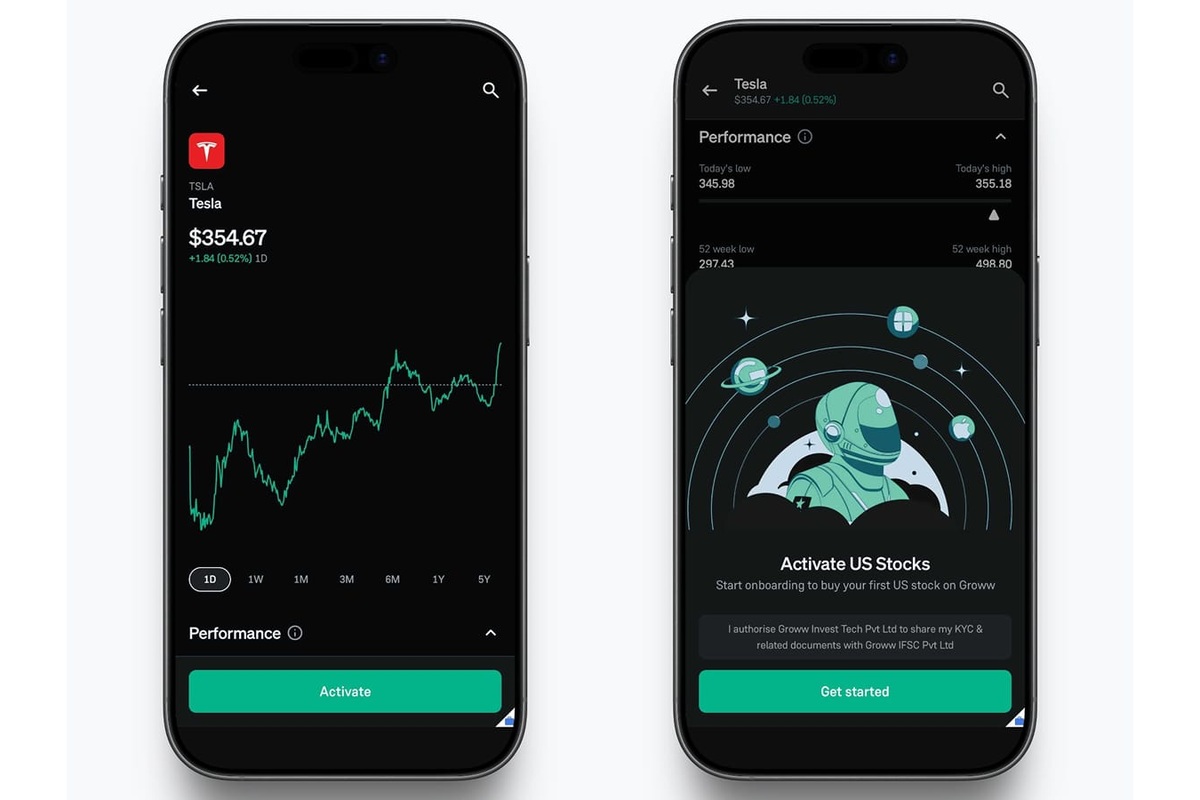
In an October 22 product announcement, Groww said its U.S. stocks and ETFs service was available to all users after an earlier phased launch. The platform offers more than 10,000 U.S.-listed stocks and ETFs, alongside fractional-share investing.
Fractional ownership allows customers to buy part of an eligible share rather than funding an entire unit. It lowers the amount needed to build a position in a high-priced stock, although the cost of executing and funding the purchase remains a separate consideration.
The offering includes individual companies and funds tracking broader markets, giving users a choice between selecting businesses and buying diversified exposure. Groww also allows investors to view their U.S. holdings alongside their other investments in the app.
The practical change is distribution: investors can reach an overseas market through a platform they already use. Groww’s setup includes an activation process, personal financial information and a linked bank account, rather than treating U.S. purchases as ordinary rupee-denominated domestic trades.
Zerodha’s Service Remains in Beta
Zerodha’s official guide identifies U.S. investing as a beta feature on Kite web. It describes access to up to 2,000 U.S.-listed stocks and around 1,000 ETFs through its Global stocks segment, routed through BSE’s India INX Global Access in GIFT City.
The initial service is for resident Indians with individual accounts. Joint accounts, non-individual entities and non-resident Indians are not eligible under the published conditions.
Its product menu also has limits. Zerodha says Bitcoin ETFs and leveraged ETFs are excluded, and U.S. IPO applications are not supported. Eligible stocks can be purchased after listing, so overseas-market access should not be confused with an allocation in a new offering.
These differences matter as brokerages compete for the same customers. Groww’s live rollout and Zerodha’s beta represent different stages of availability, while the number and type of instruments supported vary by platform.
U.S. Technology Exposure Draws Interest
CNBC reported that India’s Nifty 50 had fallen nearly 13% this year while the S&P 500 had gained more than 12%. Brokerage executives cited that performance gap, interest in AI companies and currency diversification as reasons for rising overseas demand.
Foreign exposure gives Indian investors access to businesses and sectors that may be difficult to replicate through a purely domestic portfolio. However, buying several popular technology names can still leave a portfolio concentrated in closely related earnings and valuation risks.
Interest in international shares also coexists with demand for large domestic listings. Jio’s shares opened about 21% above their IPO price on October 28, as we reported earlier, after India’s record $3.2 billion offering.
The two developments show the widening range of choices available to retail investors: a separately listed Indian digital-services business at home and established global companies through local brokerage apps.
Small Purchases Still Carry Trading Costs
Groww’s published fee schedule lists brokerage of 0.1% of the transaction value or $1 per executed order, whichever is higher. Account opening and maintenance are listed at zero, but those charges do not represent the full cost of investing.
For an illustrative $100 order, the $1 minimum would amount to 1% of the purchase before other charges. Groww also lists 18% GST on brokerage and applicable U.S. regulatory fees. A later sale is another transaction with its own charges.
Currency conversion is an additional consideration. Groww says it does not impose its own forex conversion charge, while deposits and withdrawals are converted at bank rates. A platform’s zero conversion fee therefore does not necessarily mean exchanging rupees and dollars is cost-free.
Currency and Remittance Rules Still Apply
The RBI’s remittance framework permits resident individuals to remit up to $250,000 per financial year for permitted current and capital-account transactions combined. The allowance is shared across eligible purposes, rather than being a separate investment-only limit.
Currency movements also affect the value eventually received in rupees. A stronger dollar can lift the rupee value of a dollar-denominated holding, while a strengthening rupee can reduce it, independently of the underlying share-price move.
The brokerages’ expansion makes overseas investing easier to access. For customers, the outcome will still depend on the securities they own, the price paid, exchange-rate movements and the full cost of moving money and trading.