Key Notes
- Musk expects total Starlink bandwidth to grow about 100-fold within two to three years through upgraded satellites and faster deployment.
- His orbital AI strategy hinges on reusable Starship launches eventually costing less than $100 per kilogram.
- He forecasts major productivity gains from humanoid robots and separately sets a Neuralink goal of restoring movement in people with paralysis.
Elon Musk expects Starlink’s total network capacity to increase about 100-fold within two to three years, a forecast that puts satellite deployment at the center of SpaceX’s (Nasdaq: SPCX) next expansion. He also argued that moving AI computing into orbit would be essential for the United States to compete with China.
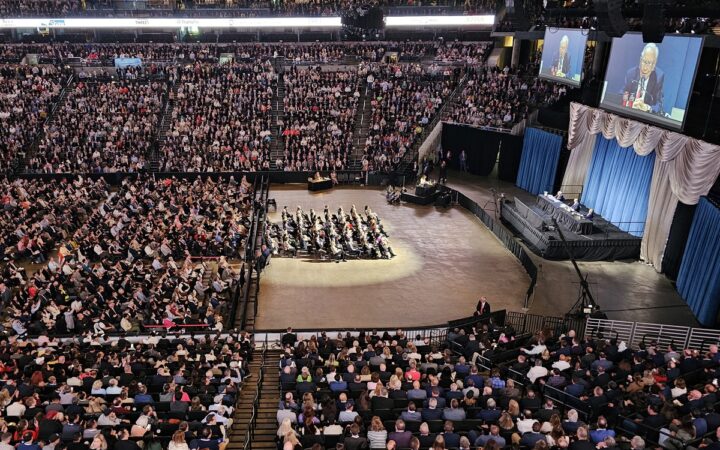
Musk outlined those ambitions in a conversation with investor Ron Baron on November 6. The appearance at the Baron Investment Conference brought together his plans for cheaper launches, satellite communications and humanoid robots, alongside a broader prediction that advanced AI could eventually meet human material needs.
In a separate November 7 post, Musk said Neuralink could enable people to walk and use their hands again in the coming years. That is a future goal; the company’s current clinical work centers on controlling external devices through brain signals.
In the coming years, @Neuralink will enable people to walk and use their hands again
— Elon Musk (@elonmusk) November 7, 2026
Starlink’s Capacity Forecast Rests on New Satellites
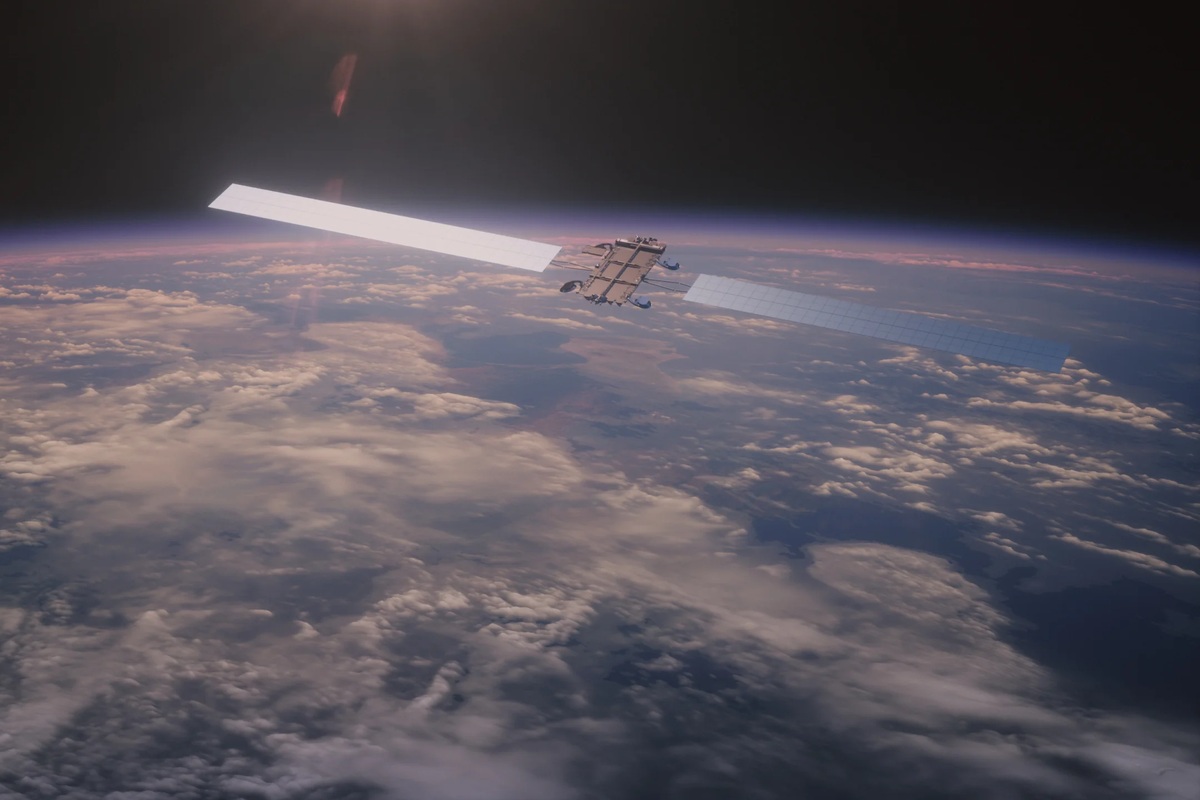
The 100-fold projection combines two assumptions: substantially more capable satellites and a much faster deployment rate. Musk said the V3 generation would offer more than 10 times the capability of V2, while SpaceX would launch roughly 10 times as many.
SpaceX’s published V3 specifications describe a satellite designed for 1 terabit per second of downlink capacity, about 10 times V2’s level. The company also projects roughly 20 times as much capacity deployed per Starship launch as a Falcon 9 launch carrying V2 satellites.
Deployment has begun. Starlink said in its October 6 update that the first 26 V3 satellites went up at the end of September, joining a constellation of more than 11,000 satellites.
Musk’s forecast concerns aggregate network bandwidth. Individual customers’ speeds will also depend on local demand, ground infrastructure and the service they buy. More capacity gives SpaceX room to serve additional users and carry more traffic, while the revenue earned from that capacity depends on utilization and pricing.
Cheaper Launches Underpin the Orbital AI Pitch
Musk linked the US competition with China to the supply of electricity for AI. His proposed answer is computing infrastructure in space, where solar power could support expansion beyond the constraints facing large installations on Earth.
The economics rest heavily on Starship. Musk predicted that a fully reusable launch system could eventually take cargo to orbit for less than $100 per kilogram. He presented that as a future cost objective, without announcing a commercial launch price at that level.
SpaceX already has a substantial financing commitment to computing on the ground. Musk announced the closing of a $40 billion financing in October, primarily for graphics processors due to arrive in the first half of 2027. Orbital computing would extend that investment strategy into a different operating environment, with launch and satellite hardware becoming part of the cost of supplying AI.
His latest revenue forecast calls for roughly 70% sequential growth in the fourth quarter. The space-computing argument reaches much further ahead: it depends on reusable rockets making large deployments economical.
The Robot Productivity Bet
For Tesla (Nasdaq: TSLA), Musk’s productivity argument centers on humanoid robots. He estimated that they could eventually deliver around five times a person’s weekly output, combining round-the-clock availability with faster movement.
A week contains 168 hours, compared with a conventional 40-hour workweek. Actual output would also reflect charging, maintenance, reliability and the tasks a robot can perform. Musk’s fivefold estimate is an operating assumption, rather than a demonstrated result across workplaces.
Tesla’s quarterly update lists Optimus manufacturing in California as an early ramp and its Texas operation as under construction. The company says production-quality robots have begun coming off its Fremont lines, with further hardware and manufacturing changes planned.
Musk’s prediction of AI-driven abundance draws on the same premise: increasingly capable software and machines would expand the supply of goods and services. The conference did not establish a timetable or an economic model demonstrating that outcome.
Neuralink’s Present Work and Next Ambition
Neuralink’s clinical trials aim to let people with paralysis operate computers by thinking about movement. The implant reads neural activity and converts it into commands; some participants are also testing devices such as robotic arms and wheelchairs.
The devices remain investigational and are not approved by the FDA. Restoring movement in a person’s own limbs would go beyond the external-device control described in the company’s current trial materials. Musk’s post announced that ambition, without presenting new clinical results demonstrating it.