Key Notes
- SpaceX caught Starship’s upper stage at Starbase on November 14 after 14 orbits.
- Flight 15 also deployed 26 Starlink V3 satellites.
- Super Heavy was lost on Friday, leaving the planned recovery of both stages incomplete.
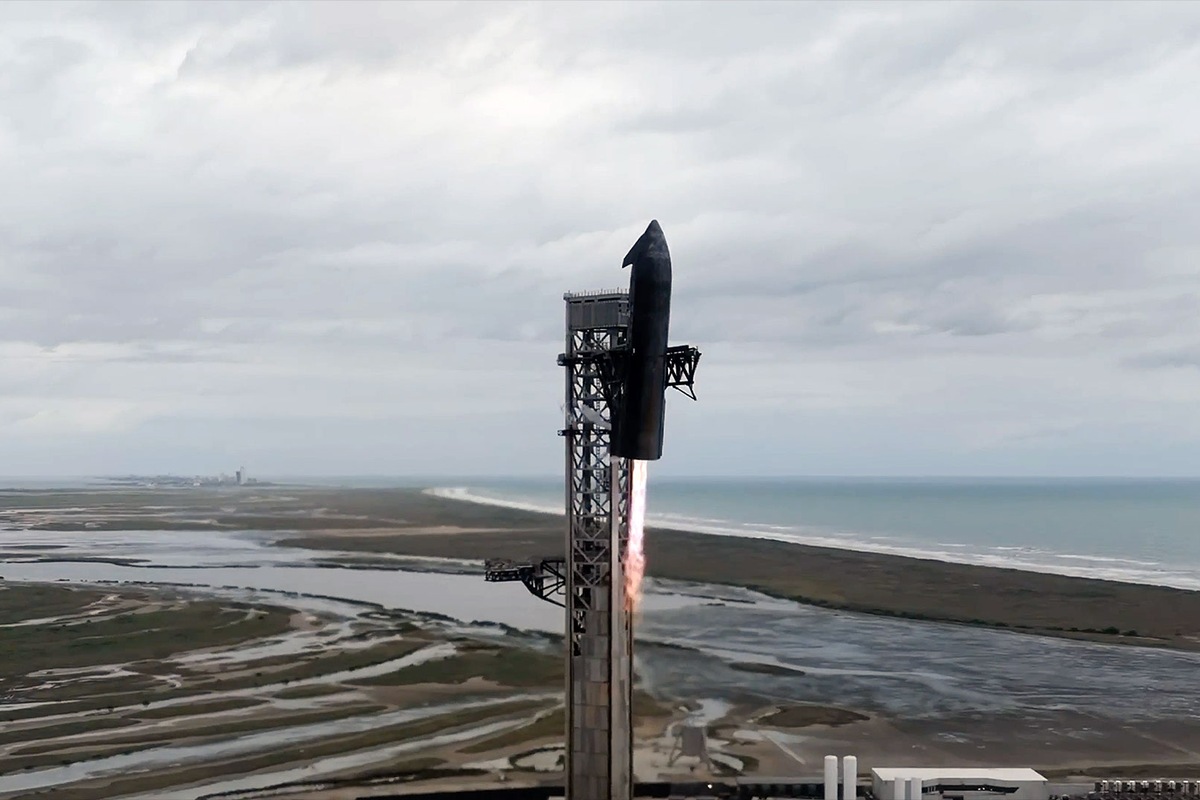
SpaceX (Nasdaq: SPCX) caught Starship’s upper stage at its Texas launch tower on Saturday, November 14, completing the spacecraft’s first return from orbit to the giant mechanical arms known as “chopsticks.”
The recovery followed 14 orbits and more than 22 hours in space. It closed a major gap in SpaceX’s effort to make Starship reusable, a program with a direct commercial role in expanding the Starlink satellite network. The mission also lost its Super Heavy booster, leaving the planned recovery of both stages incomplete.
The Spacecraft Comes Home From Orbit
Ship 42 returned to Starbase after launching on November 13 on Starship’s 15th integrated test flight. Its successful catch was a first for the upper stage, which travels into orbit, rather than a repeat of the booster recoveries SpaceX had already demonstrated.
SpaceX’s mission plan called for a roughly 275-kilometer orbit, satellite deployment and a return to the same launch site. Controllers would approve the tower approach only after checking the systems needed for atmospheric reentry, the landing burn and final maneuvering.
The distinction between the two stages matters. Super Heavy supplies the initial lift, while Starship continues into space. Recovering the spacecraft requires it to survive reentry before its engines slow and position it for the tower’s arms.
Starlink Gives the Flight a Commercial Purpose
Flight 15 deployed 26 Starlink V3 satellites, adding a revenue-generating task to the recovery test. SpaceX says each V3 satellite is designed to add one terabit per second of capacity, with the batch equivalent to about 10 Falcon 9 launches carrying V2 Mini satellites. Newly deployed satellites still require checkouts and orbital adjustments before serving customers.
For SPCX shareholders, that connects the engineering milestone to a business already producing substantial earnings. SpaceX’s quarterly report shows connectivity revenue of $5.248 billion and operating income of $2.367 billion in Q3. Starlink ended September with 13.6 million consumer subscriptions.
The company’s recent earnings results also showed a much larger AI business. Starship’s immediate commercial job remains delivering the satellites that support connectivity growth.
The Booster Loss Leaves Work Unfinished
Super Heavy did not return to the tower on Friday. It diverted offshore and exploded before reaching the water, so Flight 15 achieved the spacecraft catch without recovering the complete launch system.
That is a substantial advance over September’s orbital flight, which delivered satellites but ended without a spacecraft recovery. SpaceX now has a returned upper stage to inspect as it works toward reflying the hardware.
The commercial payoff depends on repeating that process reliably. Bringing back and reusing spacecraft could reduce replacement hardware needs and support more frequent satellite launches. Recovering both stages, checking their condition and flying them again are the steps that turn a spectacular catch into a repeatable transport system.