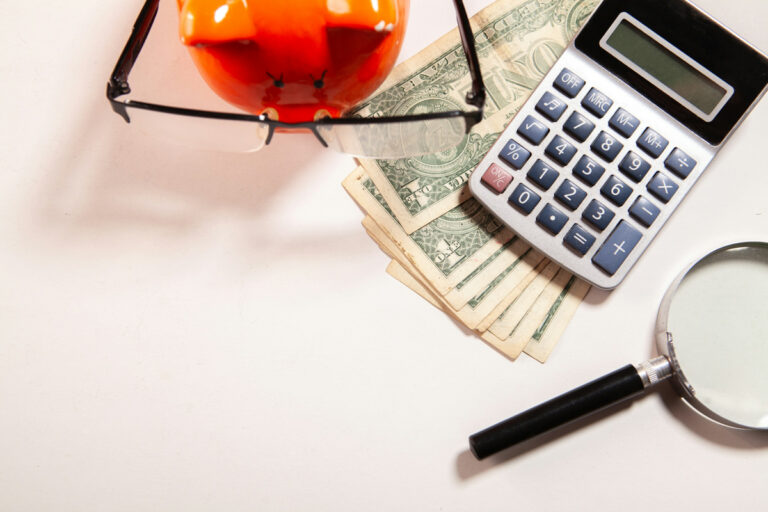
A calculator and dollar banknotes illustrate the calculations behind bond yields. Purchase price and repayment terms shape the return implied by a coupon. Photo: Sasun Bughdaryan / Unsplash
Learn how coupon rate, current yield, yield to maturity and yield to worst differ, with worked examples showing how price changes a bond’s implied return.
A bond advertised with a 5% coupon does not necessarily offer a 5% return to its next buyer. The coupon describes interest paid on face value. The investor’s purchase price, repayment date, and the bond’s contractual terms help determine its yield.
This guide builds on our explanations of bond duration and bond ladders. It separates the main yield measures and shows how to read them without confusing expected income with a guaranteed investment outcome.
What Is Bond Yield?
Bond yield expresses an income or cash-flow relationship as a percentage. There are several measures because investors ask different questions: how much interest arrives, what that interest represents relative to price, or what the full payment schedule implies.
FINRA distinguishes coupon rate, current yield, yield to maturity, yield to call, and yield to worst. A quoted percentage needs its label before it can be interpreted or compared.
Coupon Rate Measures the Promised Interest
For a conventional fixed-rate bond, the coupon rate applies to its face value. A $1,000 bond with a 5% coupon promises $50 in annual interest, provided the issuer meets its obligations. Semiannual payments would divide that amount into two $25 installments.
Buying that bond for $950 or $1,050 does not change the scheduled $50 annual coupon. The new purchase price changes the investor’s economics, rather than rewriting the issuer’s interest promise.
Vanguard’s bond overview explains the distinction between coupon, face value, and price. Floating-rate and inflation-linked securities have additional features; the fixed-payment examples here should not be applied to them without adjustment.
Current Yield Relates Income to Price
Current yield is the annual coupon payment divided by the bond’s current market price. Multiply the result by 100 to express it as a percentage.
At a $950 price, the $50 annual coupon produces a current yield of approximately 5.26%. At $1,050, the same coupon produces approximately 4.76%. The interest payment is identical, but the amount paid to obtain it differs.
This measure leaves out the gain or loss between the purchase price and the eventual repayment amount. It also leaves out coupon reinvestment. Current yield therefore describes an income relationship, not the complete return from holding the bond.
Yield to Maturity Includes the Full Schedule
Yield to maturity, or YTM, is the discount rate that makes the present value of scheduled coupons and principal repayment equal the bond’s price. It incorporates when payments arrive and whether the investor buys above or below the amount repaid at maturity.
The SEC’s investor bulletin explains why premium and discount prices produce yields different from the coupon rate.
YTM assumes the contractual payments occur as scheduled. Achieving the corresponding compounded return over the full holding period also depends on reinvesting interim coupons at that yield. Spending the coupons or reinvesting them at different rates changes the terminal wealth calculation.
One Bond, Three Purchase Prices
Consider a hypothetical noncallable bond with $1,000 face value, five years remaining, and a 5% coupon paid annually. It pays $50 at each year-end and repays $1,000 alongside the fifth coupon.
Purchase Price
Coupon Rate
Current Yield
Yield to Maturity
$950
5.00%
5.26%
6.19%
$1,000
5.00%
5.00%
5.00%
$1,050
5.00%
4.76%
3.88%
The discounted purchase includes a $50 increase from purchase price to principal repayment. The premium purchase includes a $50 decrease. YTM reflects those differences and the timing of every payment; current yield does not.
These rounded calculations use annual compounding and purchase immediately after a coupon date, with no accrued interest, fees, or taxes. They are illustrative, not market quotes. Different payment frequencies or yield conventions can produce different quoted figures.
Yield to Call and Yield to Worst
A callable bond allows the issuer to repay early under specified conditions. Yield to call calculates the yield using a call date and call price instead of the final maturity date and repayment amount.
For a premium-priced bond, an earlier repayment can shorten the time available to earn coupons before the premium is lost. A high coupon can therefore coexist with a less attractive yield to call.
Yield to worst compares the relevant contractual redemption scenarios and identifies the lowest calculated yield, assuming no default. Fidelity explains the relationship between call and maturity yields. Check the full call schedule rather than relying only on the printed maturity date.
“Worst” is not a promise about maximum loss. Default, an unfavorable early sale, or other events outside those payment assumptions can produce a worse result.
Why Prices and Yields Move Oppositely
When scheduled cash flows stay fixed, paying more for them lowers the implied yield; paying less raises it. If comparable new bonds offer higher yields, an older fixed-rate bond generally needs a lower price to compete.
The coupon itself can remain unchanged throughout that repricing. Our duration guide explains sensitivity to yield changes, while the yield curve guide explains comparisons across maturities.
Yield and Realized Return Are Different
Realized return depends on what actually happens: payments received, reinvestment income, purchase and sale prices, costs, and applicable taxes. A yield calculated at purchase cannot know all those future outcomes.
For example, buy a bond for $1,000, receive $50 in interest over one year, and sell it for $940. The $60 capital loss exceeds the coupon, leaving a $10 loss, or 1%, before fees and taxes. A positive coupon did not prevent a negative holding-period return.
FINRA explains why income and changes in value must both enter the return calculation. Inflation also affects what any resulting gain can buy.
Reading Yields on Bond Funds
A fund’s distribution rate and the yield of its underlying portfolio answer different questions. Check the calculation period, annualization method, expenses, and whether the figure describes past distributions or estimated portfolio cash flows.
A fund-level yield does not promise the same investor return. Investor.gov warns that bond funds can lose value through interest-rate, credit, and prepayment risks, including funds holding government bonds.
What to Check Before Comparing Bonds
Compare the same yield measure using current, executable prices and consistent conventions. Then examine maturity, credit quality, currency, call provisions, fees, and taxes. A larger yield may compensate for risks that a smaller number does not carry.
FINRA’s due-diligence guide places yield alongside those contractual and credit considerations. The useful comparison connects the percentage to the actual cash flows, the price paid, and the circumstances that could prevent the expected payments.
Frequently Asked Questions
Is Bond Yield the Same as Coupon Rate?
No. A fixed coupon applies to face value, while yield measures also relate payments to price or the full cash-flow schedule. A bond bought above or below face value can have a yield different from its coupon rate.
How Do You Calculate Current Yield?
Divide the annual coupon payment by the current market price and multiply by 100. A $50 annual coupon on a bond priced at $950 gives a current yield of approximately 5.26%.
Does Yield to Maturity Guarantee My Return?
No. It is a calculation based on scheduled payments and the purchase price. Default, early sale, different coupon reinvestment rates, costs, and taxes can cause the investor’s realized result to differ.
What Does Yield to Worst Mean?
It is the lowest calculated yield among the relevant contractual redemption scenarios, assuming the issuer does not default. It does not describe the maximum possible loss.
Why Does a Bond’s Yield Rise When Its Price Falls?
If scheduled payments stay unchanged, a lower purchase price means paying less for the same cash flows. That raises the implied yield, even though the coupon payment itself has not changed.