Key Notes
- Starlink Mini 2 adds a removable battery rated for up to 4.5 hours, with Wi-Fi 6 and 60-watt USB-C charging.
- US preorders are invitation-only for selected customers, with broader availability planned and no public price or shipping date listed.
- The launch expands a connectivity business that generated about 85% of SpaceX’s third-quarter operating income.
SpaceX (Nasdaq: SPCX) has introduced Starlink Mini 2, adding a removable battery to its portable satellite internet terminal as the company expands a connectivity business that supplied most of its operating profit in the third quarter.
The new terminal offers up to 4.5 hours of connectivity on one charge, Starlink says, and can also run from USB-C power. US preorders are open by invitation to selected customers, with wider availability planned for additional customers and countries.
For SPCX shareholders, the launch extends an established source of recurring revenue. SpaceX’s latest quarterly results put connectivity revenue at $5.25 billion, up 69% from a year earlier, and segment operating income at $2.37 billion. That was about 36% of group revenue and 85% of operating income.
A Battery Makes Mini More Self-Contained
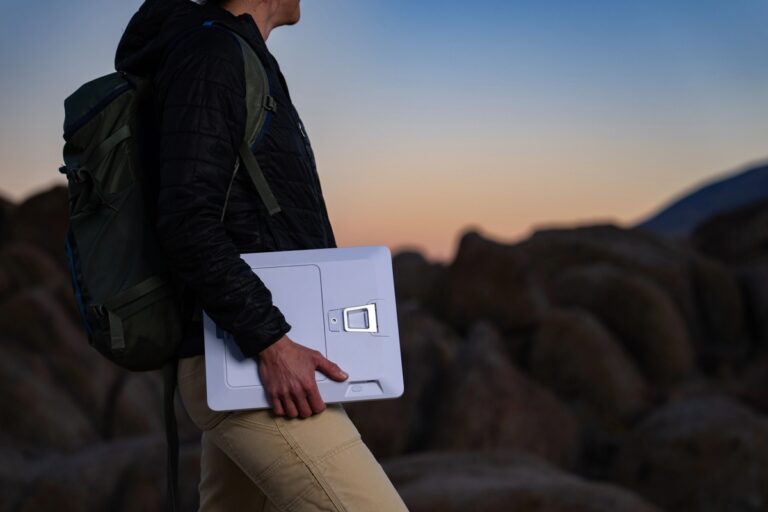
Mini 2 combines the satellite terminal, Wi-Fi router and quick-swap battery in a package weighing 1.6 kilograms with its battery and kickstand attached. The removable pack has a capacity of 71 watt-hours and weighs 490 grams, according to Starlink’s product specifications.
The kit can stay online while charging, and users can replace the battery with a spare sold separately. That removes the need to carry a separate power source for shorter sessions away from an outlet, whether at a campsite, a remote work location or a temporary outdoor setup.
Introducing Mini 2, the next-generation portable Starlink.
– Starlink (@Starlink) November 10, 2026
The connection still needs a clear view of the sky. Starlink says the device can get online in about 60 seconds under that condition; the 4.5-hour runtime is the company’s maximum claim, rather than a guaranteed duration for every installation.
Wi-Fi 6 and USB-C Simplify the Kit
Starlink lists the following hardware features:
- Wi-Fi 6, with advertised coverage of up to 1,800 square feet, or 167 square meters.
- USB-C charging at 60 watts, plus operation from USB-C power.
- An IP67 environmental rating for dust and water resistance.
- A 23.1-millimeter-thick terminal, integrated kickstand and standard camera-thread tripod mount.
The package includes the terminal, battery, kickstand, power supply and USB-C cable. Starlink’s public product page does not specify a retail price or shipment date. The initial rollout remains invitation-only, rather than a general US release.
What Mini 2 Adds to the SPCX Investment Case
Starlink ended September with 13.6 million consumer subscriptions. A terminal that can operate without a nearby outlet could make the service more practical for customers who move between locations or use it intermittently in places beyond fixed broadband coverage.
SpaceX generated $3.12 billion in consumer connectivity revenue in Q3, compared with $2.13 billion from enterprise and government customers. Mini 2 gives SpaceX another way to attract or retain paying connectivity customers, although the company has not disclosed sales targets or a revenue forecast for this model. Its contribution will depend on adoption, service pricing and how often customers keep their subscriptions active.
SpaceX is also building a broader communications business. Its planned mobile network will use infrastructure from Qualcomm (Nasdaq: QCOM), with deployment expected to begin in 2027. Mini 2 offers a nearer-term product rollout within the satellite broadband business already generating substantial operating income.
For SPCX investors, the useful measure will be whether the self-powered terminal attracts new paying customers or mainly persuades existing subscribers to replace their dishes.