Key Notes
- Microsoft plans to make Maia its primary AI inference system, with multi-gigawatt deployments starting in 2027.
- Maia 300 will enter production deployments next year, with performance claims focused on rack throughput and energy efficiency.
- Nvidia and AMD remain training partners as Microsoft seeks better operating economics across Azure and its AI services.
Microsoft Corp. (NASDAQ: MSFT) plans to make its homegrown Maia chips the primary system for running AI models across its products and services, expanding the family to multi-gigawatt deployments starting in 2027. The shift gives the company greater control over a growing part of its computing costs while reducing its reliance on outside accelerators for inference.
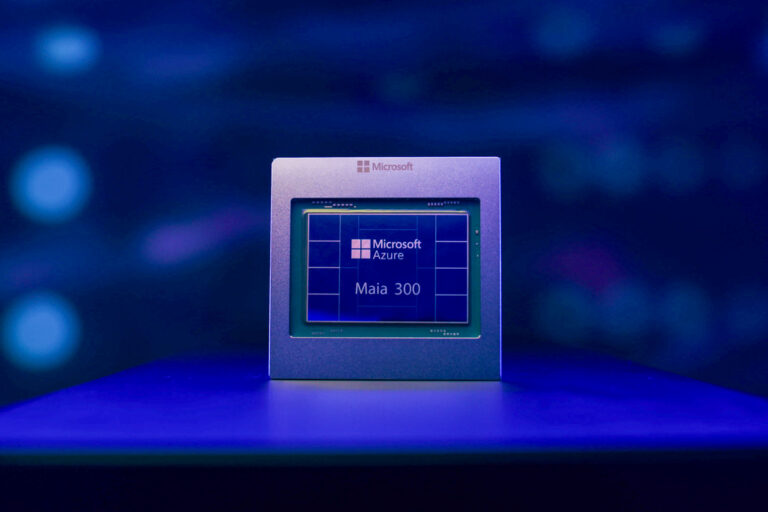
The company announced the strategy on October 12 alongside Maia 300, its third-generation AI accelerator. Production deployments of the new system will begin next year; the announcement does not mean Microsoft has already moved most of its AI workloads onto the chip.
For investors, the financial test is whether specialized hardware can improve the economics of Azure and Copilot as AI usage expands. More efficient inference can lower the resources needed to answer each request, although the eventual benefit depends on deployment, utilization and customer demand.
Inference Becomes the Focus
Inference is the process of using a trained model to generate an answer, write code or complete another task. Unlike training a model, it repeats whenever users interact with a service, making the cost of each request important as adoption grows.
Microsoft’s earlier Maia 200 launch in January already targeted that opportunity. The company described a processor designed for efficient token generation, with software tools intended to make models easier to optimize for its hardware. Tokens are the pieces of information a language model processes and produces.
Maia 200 is now serving production workloads including Microsoft Copilot and supporting the company’s MAI model-development team. GitHub Copilot and Microsoft Foundry are scheduled to follow by year-end, according to the latest announcement.
Maia 300 Targets More Output per Megawatt
Microsoft’s technical breakdown describes Maia 300 as an integrated system spanning processors, software, networking, racks and cooling. The aim is to reduce the energy and time spent moving data, rather than relying on computing power alone.
The design combines compute chiplets manufactured on Taiwan Semiconductor Manufacturing Co.’s (TWSE: 2330; NYSE: TSM) N2P process with eight HBM4 memory stacks. Each accelerator has 288 gigabytes of memory and 18 terabytes per second of memory bandwidth, according to Microsoft.
A full rack contains 96 accelerators, twice the density of Maia 200, within a 167-kilowatt power envelope. Microsoft says that configuration can deliver up to seven times Maia 200’s rack-scale token throughput. The comparison is between complete systems, rather than a claim that one processor is seven times faster.
Separately, Microsoft expects Maia 300 to produce 40% more tokens per megawatt than leading GPU-based systems. These are company performance claims; they should not be treated as independently established savings across every model or workload.
Nvidia Remains Part of the Strategy
The inference push does not end Microsoft’s relationship with Nvidia Corp. (NASDAQ: NVDA). Microsoft continues to work with Nvidia and Advanced Micro Devices Inc. (NASDAQ: AMD) on model training, general manager Alistair Speirs told CNBC, which reported the plans.
Speirs declined to give a timeline for the full multi-gigawatt expansion and emphasized flexibility in matching processors to models. CNBC also reported that Maia accelerators are not currently available for other companies to rent by the hour, limiting the external evidence available to assess their performance.
That distinction matters for both stocks. An internal chip can reduce Microsoft’s dependence on a supplier for selected tasks without eliminating demand for that supplier’s products elsewhere in its infrastructure.
Azure’s Growth Makes Efficiency Financially Important
Microsoft’s fiscal fourth-quarter earnings call shows why the operating economics matter. Azure and other cloud-services revenue rose 43% year over year, while management said customer demand continued to exceed available capacity.
Capital expenditure reached $41 billion, including finance leases. Microsoft Cloud’s gross margin was 65%, down from a year earlier as the business mix shifted toward Azure and AI infrastructure investment and usage increased. Efficiency improvements partly offset those pressures.
Those figures provide context for the chip strategy, rather than a forecast of what Maia 300 will contribute. Microsoft has not disclosed a separate revenue or profit target for the new accelerator.
The industry’s funding burden is also growing. As we reported, Intel Corp. (NASDAQ: INTC) and Broadcom Inc. (NASDAQ: AVGO) chief executives have warned that access to capital could constrain the AI buildout. Better hardware efficiency may help operating returns, but construction and equipment still require financing.
The Next Test Is Deployment
For Microsoft, the milestones now are bringing Maia 300 into production and demonstrating its economics across real services. Investors will need to assess usable capacity, workload performance and cloud profitability alongside headline chip specifications.
More output from each megawatt could ease a practical constraint on growth. Whether it improves margins, supports lower customer prices or enables more spending will depend on how Microsoft balances efficiency gains against expanding demand.