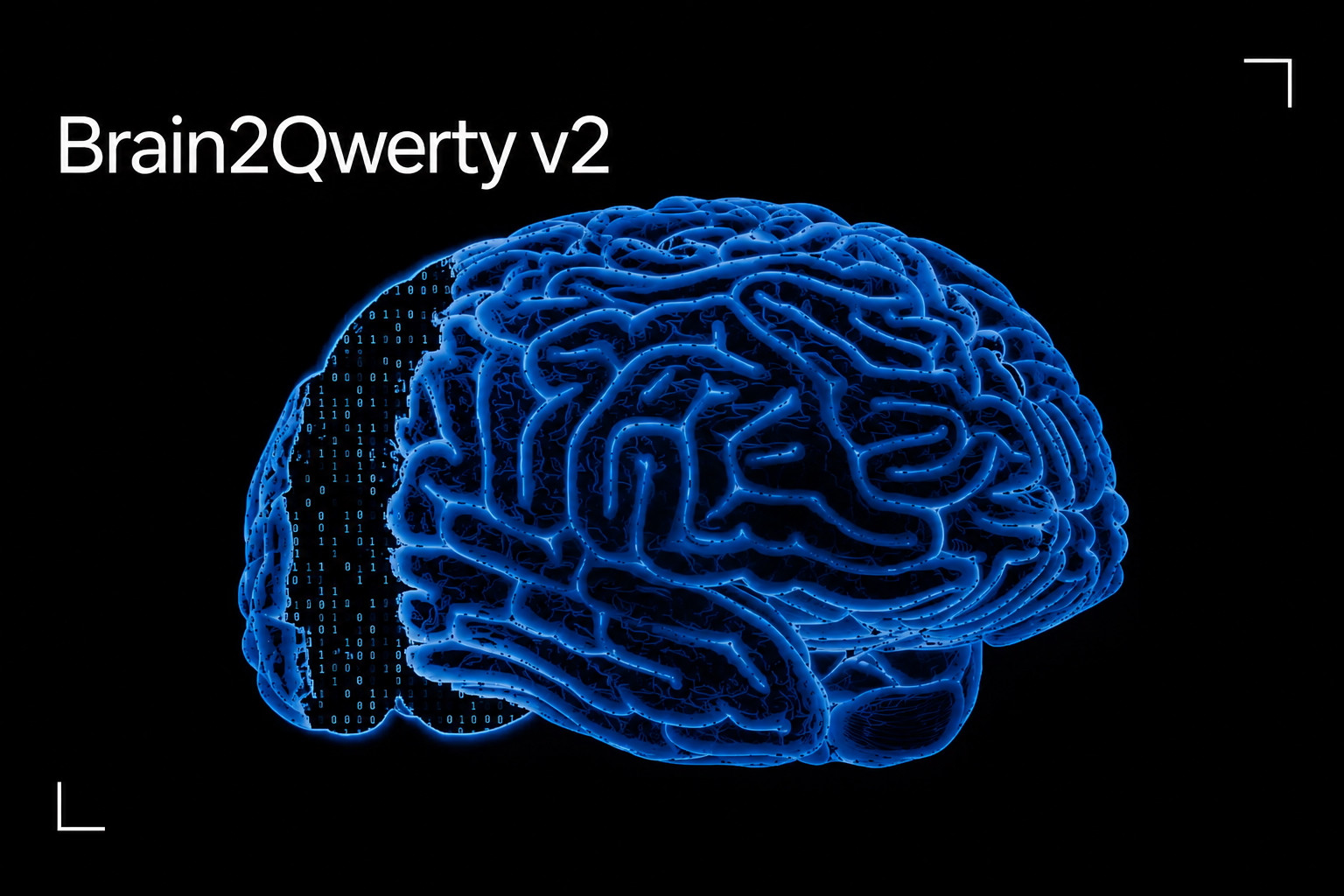
Meta has introduced Brain2Qwerty v2, a new AI system that can convert brain activity into text without requiring a surgically implanted chip.
The system uses magnetoencephalography, or MEG, to record brain activity while a person types. AI then decodes noisy neural signals and reconstructs them into readable sentences.
Meta says Brain2Qwerty v2 achieves 61% average word accuracy, with its best participant reaching 78% accuracy.
Non-Invasive Brain-to-Text AI
Unlike invasive brain-computer interfaces that require implanted electrodes, Brain2Qwerty v2 relies on external brain-scanning hardware.
The technology is still experimental and currently depends on bulky MEG equipment, making it far from consumer-ready.
However, the results show meaningful progress toward non-invasive brain-computer interfaces that could one day help people with neurological injuries or speech impairments communicate more easily.
AI and Neuroscience Converge
Brain2Qwerty v2 combines neural recordings with advanced AI models to interpret patterns linked to typing and language production.
Meta trained the system on significantly more data than the previous version, improving its ability to recover full sentences from brain signals.
The broader takeaway is that Meta is pushing deeper into neurotechnology, showing how AI could eventually turn brain activity into text without surgery, even though the technology remains early and limited by current hardware.