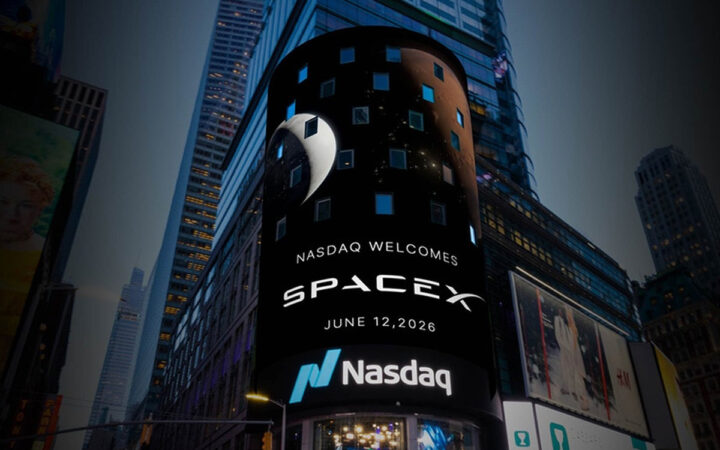
SpaceX has reportedly selected the Nasdaq exchange for its long-anticipated initial public offering, with the IPO potentially scheduled for June 11 and trading expected to begin the following day under the ticker SPCX.
The listing would mark one of the most closely watched public offerings in financial market history as investor demand for artificial intelligence, aerospace, and infrastructure-related companies continues accelerating.
SpaceX has become one of the world’s most valuable private companies due to its dominance in reusable rockets, satellite internet services, and next-generation space transportation systems.
Investor Interest Intensifies Ahead of Listing
Markets have speculated about a potential SpaceX IPO for years, though the company previously remained focused on private financing rounds.
Investor enthusiasm surrounding the listing has intensified amid the broader AI and infrastructure investment boom, with many traders viewing SpaceX as a strategic leader in satellite communications, launch systems, and future orbital computing infrastructure.
The company’s Starlink satellite business has become a major growth engine, while Starship development continues positioning SpaceX at the center of future lunar, Mars, and heavy-lift launch markets.
Analysts note that the IPO could attract enormous institutional demand given SpaceX’s unique position at the intersection of aerospace, communications, AI infrastructure, and defense technology.
The expected ticker symbol SPCX has already generated significant discussion across financial markets and retail trading communities.
Potentially Historic IPO for U.S. Markets
A public listing would likely rank among the largest technology IPOs ever completed, potentially reshaping benchmark indices and investor exposure to the aerospace sector.
Some strategists believe the offering could further intensify momentum across speculative growth stocks, particularly within AI, semiconductors, and space-related industries.
At the same time, analysts caution that valuations surrounding high-profile private technology firms have risen sharply amid aggressive investor optimism tied to artificial intelligence and infrastructure expansion.
SpaceX’s potential debut also arrives during a period of heightened competition in launch systems, satellite internet, and orbital computing initiatives as governments and corporations increase investment into space-based infrastructure.
For Nasdaq, securing the listing would represent a major victory in the competition for blockbuster technology IPOs.
The broader takeaway is that SpaceX has evolved far beyond a traditional aerospace company, becoming one of the defining infrastructure and technology firms of the modern AI-driven economy.