Asian Markets Lose Over $300 Billion as Taiwan, Korea, and Japan Stocks Slide
Asian stock markets suffered a sharp selloff as Taiwan, South Korea, and Japan erased more than $300 billion in combined market value during a broad regional decline.
Stay on top of moves across global financial markets. This category brings together timely reporting and clear analysis on equities, commodities, futures & derivatives, foreign exchange, cryptoassets, ETFs and fixed income. We highlight market movers, earnings, policy shifts and liquidity trends, connecting headlines to price action and sentiment. Whether you trade intraday or invest for the long term, you’ll find context on volatility, macro drivers and sector rotations, plus quick rundowns of what matters before the open and after the close. Use Markets as your single hub to track risk, hedge exposures and spot opportunities across asset classes and regions.
Asian stock markets suffered a sharp selloff as Taiwan, South Korea, and Japan erased more than $300 billion in combined market value during a broad regional decline.
ClickHouse tripled its annual recurring revenue to $250 million over the past year as the database company prepares for a potential IPO in the coming years.
South Korea became the second country after the United States to have more than one public company valued above $1 trillion, led by Samsung and SK Hynix.
SK Hynix officially joined the $1 trillion market cap club after shares surged 11%, fueled by record earnings and booming demand for AI memory chips used in Nvidia systems.
South Korea’s KOSPI surged to a record high after gaining roughly $220 billion in market value, driven by sharp rallies in Samsung and SK Hynix shares.
Elon Musk reportedly discussed the possibility of merging SpaceX and Tesla into a single company, creating a combined entity valued at nearly $2.85 trillion.
Micron became a $1 trillion company for the first time after shares surged 18% in a single session, driven by explosive demand for AI memory chips and tightening global supply.
Quantum computing company Quantinuum is seeking to raise about $1.05 billion in its Nasdaq IPO at a valuation near $12.7 billion, with the U.S. government expected to purchase a $100 million stake.
Taiwan officially became the world’s fifth-largest stock market after total market capitalization reached $4.95 trillion, driven largely by the explosive rally in TSMC shares.
Oil prices plunged nearly 10% in a single day as easing geopolitical tensions and expectations of a potential Iran agreement triggered a sharp commodity selloff.
U.S. equity markets rallied sharply as optimism surrounding a potential peace agreement between the United States and Iran pushed S&P 500 and Nasdaq futures to fresh record highs.
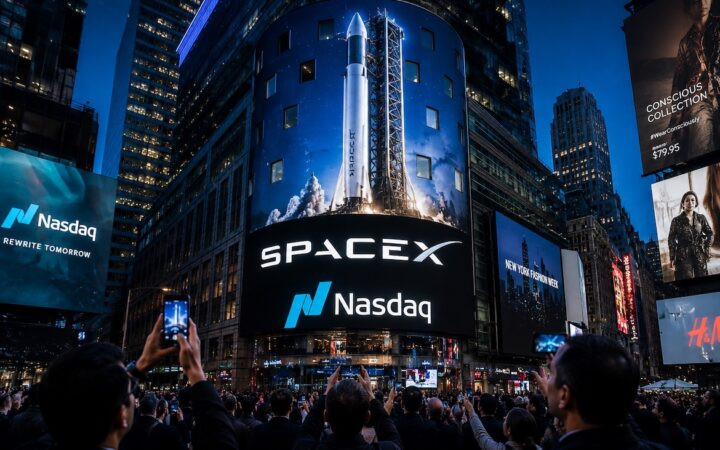
SpaceX officially filed for what could become the largest IPO in history, targeting a $1.75 trillion valuation and seeking to raise $75 billion as investors gain their first detailed look into the company’s finances, AI ambitions, and Starlink profitability.
Polymarket, in partnership with Nasdaq, introduced prediction markets tied to private companies, expanding speculative trading beyond public equities and cryptocurrencies.
Leopold Aschenbrenner’s hedge fund grew from $225 million to $13.7 billion by betting on AI infrastructure, energy, and compute bottlenecks rather than chatbot applications.
The SEC is reportedly preparing an ‘innovation exemption’ that could allow tokenized versions of stocks to trade on crypto platforms, marking a major step toward integrating blockchain infrastructure into U.S. equity markets.