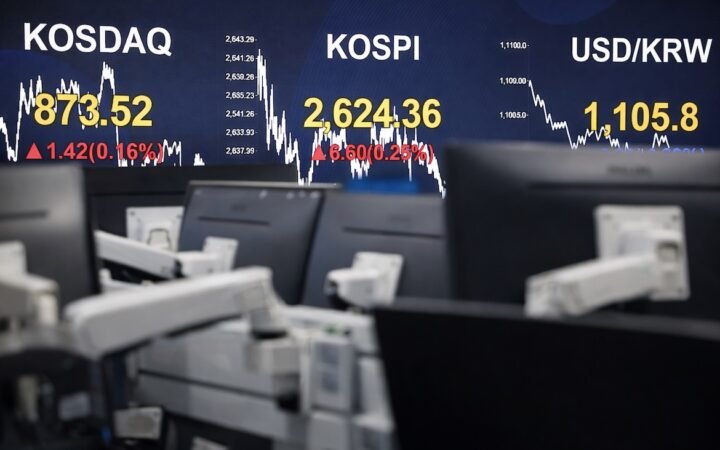
Global financial markets have entered a period of extreme turbulence as rising energy prices and escalating conflict in the Middle East trigger widespread selling across asset classes. Stocks, bonds, precious metals, and cryptocurrencies have all come under pressure as investors reassess growth and inflation risks.
In Europe, the broad STOXX Europe 600 index fell 3.2%, while Germany’s DAX dropped 3.7% as markets reacted to the sharp increase in energy costs. Government bonds also faced heavy selling pressure, particularly across European markets, where higher energy prices are fueling concerns about inflation and economic slowdown.
The selloff reflects growing fears that the conflict could trigger a stagflationary shock, combining slower economic growth with rising costs.
Energy Prices Drive Market Panic
Oil prices have surged as supply concerns intensify. U.S. crude climbed above $77 per barrel, marking its highest level since January 21, 2025 – the day after President Donald Trump’s inauguration – effectively reversing the entire decline in oil prices seen during his presidency.
Natural gas prices have also surged. According to reports from Sky News, gas prices in the United Kingdom have jumped 93%, with the benchmark price exceeding $700 for the first time since 2023.
The surge in energy costs has raised alarm across financial markets. Emmanuel Cau, head of European equity strategy at Barclays, described the market reaction bluntly: “This is panic selling. This is fear of stagflation. The market underestimated the scale of this war.”
Higher energy costs threaten to ripple through global supply chains, raising inflation pressures and complicating central bank policy decisions.
Trillions Wiped Out Across Asset Classes
The market turmoil has erased an estimated $4.7 trillion across major asset classes within roughly 11 hours. Precious metals experienced some of the largest declines after earlier surges.
Gold fell 7%, wiping out roughly $2.6 trillion in market value, while silver dropped 12.3%, erasing about $610 billion.
Equity markets also took heavy losses. The S&P 500 declined 1.88%, destroying about $1.14 trillion in capitalization. The Nasdaq fell 2.13%, losing approximately $845 billion, while the Russell 2000 dropped 3.17%, wiping out roughly $100 billion.
Cryptocurrencies were not immune. Bitcoin slipped about 3%, reducing the market’s value by roughly $40 billion.
The scale and speed of the selloff highlight how sensitive global markets have become to geopolitical shocks. Rapid cross-asset movements suggest investors are quickly repricing risk across commodities, equities, and digital assets simultaneously.
For now, markets remain on edge as energy prices, geopolitical developments, and macroeconomic fears collide. Analysts warn that volatility could remain elevated until clearer signals emerge regarding both the conflict and the stability of global energy supply.