Nvidia and Uber announced plans to launch Level 4 autonomous robotaxis in 28 cities by 2028. The partnership aims to scale AI-powered self-driving fleets across major urban markets.
By Emma Clarke | Edited by Oleg Petrenko
Published:
Updated:
Nvidia and Uber revealed plans to deploy Level 4 autonomous robotaxis across 28 cities by 2028. The partnership is designed to expand AI-powered self-driving fleets in major urban markets. Photo: Uber
Nvidia and Uber announced plans to launch Level 4 autonomous robotaxis across 28 cities by 2028, marking one of the most ambitious deployments of self-driving vehicles to date.
The initiative will integrate Nvidia’s artificial intelligence computing platforms with Uber’s global ride-hailing network to operate fleets of autonomous vehicles capable of driving without human intervention in defined urban environments.
The companies aim to begin early deployments as soon as next year, starting with selected cities before expanding the network globally.
AI and Autonomous Driving Converge
Level 4 autonomy allows vehicles to operate independently in most conditions within designated service areas, relying on advanced AI systems, sensors, and high-performance computing.
Nvidia’s autonomous driving technology will serve as the backbone of the system, processing massive volumes of real-time data from cameras, radar, and lidar sensors to navigate complex urban environments.
The company has been steadily expanding its presence in the autonomous vehicle industry through its AI software stack and high-performance computing chips designed for self-driving systems.
As previously covered, Nvidia has positioned its hardware and software ecosystem as a central platform for companies developing autonomous driving technologies.
By combining Nvidia’s computing infrastructure with Uber’s mobility network, the companies aim to accelerate commercialization of robotaxi services.
Implications for the Mobility Industry
If successful, the rollout could mark a significant step toward large-scale adoption of autonomous ride-hailing services.
Robotaxis promise to dramatically reduce operating costs by removing the need for human drivers, potentially transforming the economics of ride-sharing and urban transportation.
However, the industry still faces regulatory hurdles, safety challenges, and technological barriers before fully autonomous fleets become widespread.
Cities and regulators remain cautious about approving large-scale deployments, particularly in densely populated urban areas where safety concerns remain high.
Still, partnerships between technology companies and mobility platforms are becoming increasingly common as the race to commercialize autonomous vehicles intensifies.
The Nvidia-Uber collaboration signals that major players in both artificial intelligence and transportation believe robotaxi networks could become a major component of future urban mobility systems.
If the timeline holds, fleets powered by Nvidia’s AI platforms could begin operating in dozens of cities within the next few years.
Nvidia expects cumulative revenue from AI chips to reach $1 trillion by the end of 2027, according to CEO Jensen Huang. The forecast doubles the company’s previous projection for the fast-growing AI market.
By Emma Clarke | Edited by Oleg Petrenko
Published:
Nvidia projects that cumulative revenue from its AI chips will reach $1 trillion by the end of 2027, CEO Jensen Huang said. The estimate doubles the company’s earlier forecast, underscoring the rapid expansion of the AI market. Photo: Nvidia / Facebook
Nvidia expects cumulative revenue from artificial intelligence chips to reach $1 trillion by the end of 2027, according to CEO Jensen Huang.
The projection marks a dramatic increase from the company’s previous forecast of $500 billion in AI-related revenue through 2026, highlighting how rapidly demand for AI computing infrastructure is expanding.
Nvidia’s chips have become the backbone of the global artificial intelligence boom, powering large language models, generative AI systems, and advanced machine-learning platforms used by technology companies and enterprises worldwide.
AI Demand Drives Massive Revenue Forecast
The trillion-dollar revenue target reflects explosive growth in demand for specialized processors designed to train and run artificial intelligence models.
Large technology companies, cloud providers, and startups are investing heavily in AI infrastructure, building massive GPU clusters capable of handling increasingly complex computational workloads.
Nvidia currently dominates the market for AI accelerators, with its GPU architecture widely used in data centers across the global technology sector. The company’s hardware and software ecosystem has made it a central supplier to firms racing to develop advanced AI capabilities.
As previously covered, the surge in AI spending has triggered an unprecedented wave of investment in data centers, cloud infrastructure, and specialized semiconductor technologies.
The rapid expansion of generative AI applications across industries from finance and healthcare to software development and media has further accelerated demand for high-performance computing platforms.
AI Infrastructure Race Intensifies
Nvidia’s aggressive revenue forecast also underscores the scale of the global race to build artificial intelligence infrastructure. Major technology companies including Microsoft, Meta Platforms, and Amazon are investing tens of billions of dollars into data centers and AI computing capacity. These investments aim to secure the processing power needed to train next-generation AI models and deliver AI-powered services to businesses and consumers.
Analysts say Nvidia’s dominant position in AI hardware could allow the company to capture a significant portion of the rapidly expanding AI infrastructure market.
At the same time, the extraordinary scale of the company’s projections highlights just how central artificial intelligence has become to the future of the technology industry.
If the forecast proves accurate, Nvidia would generate revenue on a scale rarely seen in the semiconductor sector, cementing its position as one of the most influential companies in the global AI ecosystem.
Meta has invested $27 billion in AI cloud company Nebius as it races to secure computing power for artificial intelligence development. The deal highlights growing demand for large-scale AI infrastructure.
By Emma Clarke | Edited by Oleg Petrenko
Published:
Updated:
Meta has committed $27 billion to AI cloud provider Nebius as it moves to secure the computing capacity needed for artificial intelligence development. The investment underscores surging demand for large-scale AI infrastructure. Photo: Julio Lopez / Unsplash
Meta Platforms has invested $27 billion in Nebius, the artificial intelligence infrastructure firm founded by former Yandex CEO Arkady Volozh. The move signals Meta’s growing urgency to secure computing capacity as competition in the global AI race accelerates.
Shares of Nebius surged following the announcement as investors interpreted the deal as a major endorsement of the company’s role in the rapidly expanding AI cloud market.
The investment could grow further. Analysts say Meta may ultimately commit up to an additional $15 billion, potentially raising the total value of the partnership significantly as demand for computing power increases.
AI Infrastructure Becomes Strategic Priority
Artificial intelligence development now requires massive computing capacity powered by specialized GPUs and high-performance data centers. Technology giants are racing to secure these resources as demand for AI training and inference continues to surge.
Nebius has emerged as a key provider of AI cloud infrastructure, offering large-scale GPU clusters and high-performance computing platforms designed specifically for machine-learning workloads.
Meta’s investment reflects the growing recognition that access to computing infrastructure rather than algorithms alone is becoming one of the most important competitive advantages in the AI industry.
As previously covered, Meta has been accelerating investments in AI development while restructuring parts of its workforce. The company has reportedly been considering layoffs affecting more than 20% of its roughly 79,000 employees as it reallocates resources toward artificial intelligence initiatives and infrastructure expansion.
Big Tech Competes for AI Capacity
Meta is not the only technology company partnering with Nebius. Microsoft previously signed a major infrastructure agreement with the company reportedly worth about $17 billion, highlighting the scale of demand for AI computing power.
The deals illustrate a broader trend across the technology sector: major companies are investing tens of billions of dollars to secure access to specialized AI infrastructure.
Analysts say the rapid expansion of generative AI models and enterprise AI applications has created an unprecedented surge in demand for computing capacity, forcing technology firms to invest heavily in data centers, chips, and cloud infrastructure.
For Meta, the Nebius investment could help accelerate development of next-generation AI systems across its platforms, including advertising optimization, recommendation algorithms, and advanced generative AI tools.
The partnership also underscores the increasing importance of independent AI infrastructure providers that can supply computing resources at scale to multiple technology companies simultaneously.
As the AI arms race intensifies, access to large-scale computing power is emerging as one of the defining strategic assets of the technology industry.
Nebius shares surged after Nvidia announced a $2 billion investment to build next-generation AI cloud infrastructure. The partnership aims to scale high-performance computing platforms for large artificial intelligence workloads.
By Emma Clarke | Edited by Oleg Petrenko
Published:
Nebius shares jumped after Nvidia announced a $2 billion investment to develop next-generation AI cloud infrastructure. The partnership is aimed at expanding high-performance computing capacity for large-scale artificial intelligence workloads. Photo: nebiusofficial / Facebook
Nvidia announced a $2 billion strategic investment in Nebius to accelerate development of next-generation artificial intelligence cloud infrastructure, sending Nebius shares up roughly 16% following the announcement.
The partnership will focus on building full-stack AI cloud platforms, combining Nvidia’s advanced GPU hardware and software ecosystem with Nebius’s rapidly expanding data-center infrastructure. The companies aim to scale computing capacity designed specifically for training and deploying large AI models.
Demand for specialized AI infrastructure has surged globally as technology firms race to deploy generative AI tools and machine-learning systems requiring massive computational power.
Building the Next Generation of AI Cloud Infrastructure
The agreement positions Nebius as a key infrastructure partner in the rapidly expanding AI computing ecosystem. Nvidia’s investment will support the development of large-scale GPU clusters capable of handling advanced AI training workloads.
Nebius has been investing heavily in high-performance computing facilities designed for AI developers and enterprise customers. By integrating Nvidia’s latest GPU architecture and AI software stack, the company hopes to provide scalable infrastructure capable of supporting increasingly complex AI models.
As previously covered, Nvidia has increasingly pursued strategic investments and partnerships across the AI ecosystem, supporting companies building cloud platforms, data centers, and specialized computing environments.
The approach allows Nvidia to expand the reach of its technology beyond semiconductor manufacturing while helping ensure sustained demand for its GPUs, which remain central to most large AI systems.
Investor Reaction and Market Implications
Markets reacted positively to the announcement, with Nebius shares jumping about 16% as investors viewed the partnership as a major endorsement from the world’s leading AI chipmaker.
The deal also highlights intensifying competition in the AI infrastructure race. Cloud providers and technology companies are investing billions of dollars to expand computing capacity capable of supporting artificial intelligence workloads.
Analysts say partnerships between chipmakers and AI cloud providers could become increasingly common as demand for computing power continues to rise. The scale of investment required to support advanced AI systems has already pushed companies to seek strategic alliances and shared infrastructure development.
For Nvidia, the investment reinforces its strategy of building a broader AI ecosystem that extends beyond hardware into software platforms and cloud infrastructure partnerships.
For Nebius, the deal significantly strengthens its credibility in the AI infrastructure market and may accelerate its expansion into global enterprise and developer markets.
As artificial intelligence adoption accelerates across industries, access to large-scale computing power is becoming one of the most critical bottlenecks and the Nvidia-Nebius partnership aims to help address that challenge.
Mastercard unveiled a new crypto partner program linking 85 digital asset companies to expand cross-border payments and B2B transactions. The initiative aims to integrate blockchain-based transfers into mainstream financial infrastructure.
By David Sinclair | Edited by Oleg Petrenko
Published:
Updated:
Mastercard introduced a new crypto partner program connecting 85 digital asset firms to support cross-border payments and B2B transactions. The initiative is designed to bring blockchain-based transfers into the broader financial infrastructure. Photo: Pixabay / Pexels
Mastercard has launched a new cryptocurrency partner program designed to integrate digital asset infrastructure into global payments networks. The initiative brings together 85 crypto companies to support cross-border transfers and business-to-business payment solutions built on blockchain technology.
The program aims to create a standardized ecosystem where financial institutions, fintech companies, and crypto firms can collaborate on payment infrastructure, settlement systems, and digital asset services.
Mastercard said the initiative reflects growing demand for faster and more efficient international payment systems.
Building a Global Crypto Payments Network
Cross-border payments remain one of the most expensive and time-consuming areas of traditional finance. Mastercard’s new partner program seeks to address those challenges by connecting crypto infrastructure providers with established financial networks.
The initiative focuses particularly on improving B2B payments, where large transactions often face delays due to legacy banking systems and settlement processes.
By integrating blockchain technology into its network, Mastercard aims to reduce friction in international transfers while maintaining compliance and security standards required by global regulators.
As previously covered, major payment companies have increasingly explored crypto-based solutions for remittances, settlements, and digital identity systems.
Implications for the Payments Industry
The launch signals that traditional financial institutions continue to deepen engagement with digital assets despite volatility in cryptocurrency markets.
For Mastercard, the program represents a strategic effort to position itself at the center of future digital payment rails, ensuring that blockchain-based transactions can operate alongside conventional card networks and bank transfers.
Analysts say the collaboration with dozens of crypto firms could accelerate experimentation in areas such as tokenized payments, stablecoin settlements, and programmable financial services.
However, regulatory uncertainty remains a key challenge. Many jurisdictions are still defining legal frameworks for crypto payments, digital asset custody, and cross-border blockchain transactions.
Even so, Mastercard’s initiative suggests that major financial networks see long-term potential in digital asset infrastructure as part of the evolving global payments landscape.
The move also highlights a broader trend: as fintech and blockchain technologies mature, the boundaries between traditional finance and crypto markets are becoming increasingly blurred.
Japan’s massive holdings of U.S. Treasury bonds have come into focus as investors debate whether foreign selling could pressure global bond markets. Analysts say fears of large-scale liquidation highlight growing fragility in the world’s largest debt market.
By Michael Foster | Edited by Oleg Petrenko
Published:
Japan’s large holdings of U.S. Treasury bonds are drawing renewed attention as investors debate whether foreign selling could put pressure on global bond markets. Analysts say such concerns underscore growing sensitivity in the world’s largest debt market. Photo: Szymon Shields / Pexels
Japan’s position as the largest foreign holder of U.S. government debt has come under renewed scrutiny as volatility spreads across global bond markets. Investors are increasingly debating how shifts in Japanese policy or capital flows could influence the stability of the U.S. Treasury market, the backbone of the global financial system.
According to widely cited estimates, Japanese institutions collectively hold trillions of dollars in U.S. Treasury securities, making the country one of the most important overseas lenders to the United States.
The renewed attention comes as Japan faces mounting economic pressures, including currency weakness, volatility in domestic equities, and changes in monetary policy.
Why Japan’s Treasury Holdings Matter
The U.S. Treasury market, valued at roughly $30 trillion, plays a central role in global finance. Treasuries are widely used as reserve assets, collateral in financial transactions, and benchmarks for global interest rates.
Japan’s large holdings stem from decades of trade surpluses and investment flows. Japanese institutions – including banks, insurers, pension funds, and government-related entities – have historically invested heavily in Treasuries because of their liquidity and perceived safety.
However, changes in domestic conditions can alter those flows. When the Japanese yen weakens or domestic yields rise, Japanese investors may shift capital back home to capture better returns or stabilize their balance sheets.
As previously covered, the Bank of Japan’s gradual shift away from strict yield curve control policies has already begun to reshape global capital flows.
Could Foreign Selling Shake the Bond Market?
Some market commentary has suggested that large-scale selling of U.S. Treasuries by foreign holders could destabilize financial markets. In theory, heavy selling would push bond prices lower and yields higher, tightening financial conditions across the economy.
However, analysts caution that the U.S. Treasury market is among the deepest and most liquid financial markets in the world. Even substantial portfolio adjustments by foreign investors are typically absorbed by a broad range of buyers, including domestic institutions, pension funds, banks, and the Federal Reserve.
Moreover, while Japan is the largest foreign holder, its share of the overall Treasury market remains a minority portion of total outstanding debt.
Still, the debate highlights how sensitive global markets have become to shifts in capital flows. As monetary policies diverge and geopolitical tensions rise, investors are increasingly focused on who is buying or selling government debt.
For now, most analysts view the risk of a sudden, destabilizing liquidation as unlikely. Yet the attention surrounding Japan’s holdings underscores a broader reality: the global financial system remains deeply interconnected, and large changes in cross-border investment patterns can ripple through markets faster than expected.
Oil prices surged toward $120 per barrel as the conflict involving Iran intensified fears of supply disruptions through the Strait of Hormuz. Global equity markets fell sharply as energy costs spiked.
By Nathan Cole | Edited by Oleg Petrenko
Published:
Oil prices surged toward $120 per barrel as the conflict involving Iran heightened fears of supply disruptions through the Strait of Hormuz, a route that normally carries about 20% of global oil shipments. The spike in energy costs sent global equity markets sharply lower. Photo: Soly Moses / Pexels
Global markets were rocked as oil prices surged toward $120 per barrel amid escalating conflict involving Iran, raising fears of severe disruptions to global energy supplies.
Crude oil prices climbed sharply during trading, with Brent crude briefly rising above $119 per barrel – the highest level in more than three and a half years. The surge reflects mounting concerns that tensions in the Middle East could disrupt shipments through the Strait of Hormuz, one of the world’s most critical oil transport routes.
If supply flows through the strait are significantly affected, analysts warn the shock could push energy prices higher and intensify inflation pressures across the global economy.
Oil Shock Sends Stocks Lower
The rapid rise in oil prices triggered a broad selloff in equity markets. The S&P 500 fell around 2%, while the Nasdaq 100 declined roughly 2.3%. The Dow Jones Industrial Average dropped approximately 2.2% as investors reduced exposure to risk assets.
Energy markets moved in the opposite direction. U.S. benchmark WTI crude jumped about 26.5%, while Brent crude surged roughly 23% during the latest rally.
The sharp divergence highlights how energy shocks often pressure equities while boosting commodity markets. Higher oil prices increase costs for businesses and consumers, raising fears of slower economic growth and persistent inflation.
As previously covered, oil price spikes tied to geopolitical conflicts can have broad economic consequences, especially when they involve key shipping routes such as the Strait of Hormuz.
Asia-Pacific Markets Extend the Selloff
Stock markets across the Asia-Pacific region also fell sharply during morning trading as investors reacted to the escalating conflict and rising energy prices.
Japan’s Nikkei 225 dropped more than 7%, while Hong Kong’s Hang Seng index fell over 3%. Australia’s ASX 200 declined more than 4%.
South Korea’s KOSPI, which has been particularly sensitive since the conflict began, fell more than 8%, triggering a 20-minute trading halt as circuit breakers were activated.
The widespread declines underscore how quickly geopolitical shocks can ripple through global financial markets. Investors remain focused on developments in the Middle East, particularly any signs of disruptions to energy infrastructure or shipping routes.
For now, the surge in oil prices and the simultaneous decline in global equities reflect a classic risk-off reaction as markets brace for the potential economic consequences of prolonged conflict.
BlackRock capped investor withdrawals from its $26 billion HPS Corporate Lending Fund after redemption requests surged to about $1.2 billion. The move highlights growing stress in the rapidly expanding private credit market.
By Michael Foster | Edited by Oleg Petrenko
Published:
BlackRock limited investor withdrawals from its $26 billion HPS Corporate Lending Fund after redemption requests climbed to roughly $1.2 billion. The decision underscores rising pressure in the fast-growing private credit market. Photo: BlackRock
BlackRock has restricted investor withdrawals from its flagship private credit vehicle, the HPS Corporate Lending Fund, after redemption requests surged well beyond the fund’s quarterly limits.
Investors sought to withdraw approximately $1.2 billion from the fund about 9.3% of its roughly $26 billion in assets under management. However, the fund allowed withdrawals of only about 5%, equivalent to roughly $620 million, in line with its redemption cap.
The move has drawn attention across financial markets because it highlights liquidity pressures in the fast-growing private credit industry, which has become a major alternative to traditional bank lending.
Why the Fund Restricted Withdrawals
Private credit funds typically invest in long-term corporate loans that cannot be quickly sold without significant price concessions. As a result, many funds impose redemption limits designed to prevent sudden investor withdrawals from forcing distressed asset sales.
BlackRock’s decision reflects these structural constraints rather than a collapse in the underlying portfolio. However, the surge in redemption requests suggests investors may be reassessing exposure to private credit amid rising interest rates, economic uncertainty, and tightening financial conditions.
As previously covered, private credit markets have expanded rapidly over the past decade as banks pulled back from certain lending activities. The sector is now estimated to be worth roughly $1.8 trillion to $2 trillion globally.
Because these funds often finance mid-sized companies that rely heavily on non-bank lending, any liquidity stress in the sector could ripple into broader corporate financing conditions.
Concerns Over a Potential Domino Effect
The restriction has sparked debate among investors about whether redemption pressures could spread across the private credit industry. If withdrawals accelerate, funds may face increasing pressure to sell loans or mark down asset values, potentially triggering wider losses.
Such dynamics could also affect companies that depend on private credit financing. If funds tighten lending standards or reduce exposure, some borrowers could face refinancing challenges, increasing default risk across segments of the market.
Shares of BlackRock and other alternative asset managers came under pressure following the news, reflecting investor concern that redemption trends could signal deeper stress in the sector.
Analysts note that the private credit market’s rapid growth has created a systemically important pool of capital outside traditional banking channels. While redemption limits are standard in the industry, sudden spikes in withdrawal requests can still test the resilience of the model.
For now, the situation underscores the trade-off at the heart of private credit investing: higher yields in exchange for reduced liquidity. As investors reassess risk exposure, the sector may face closer scrutiny from both markets and regulators.
U.S. equities lost nearly $1 trillion in market value shortly after the opening bell as major indexes fell across the board. The decline hit large-cap tech and small-cap stocks alike.
By Sophia Reynolds | Edited by Oleg Petrenko
Published:
U.S. stocks shed nearly $1 trillion in market value shortly after the opening bell as major indices declined broadly. The selloff affected both large-cap technology names and smaller-cap companies. Photo: www.kaboompics.com / Pexels
U.S. equity markets suffered a sharp selloff shortly after the opening bell, wiping out nearly $1 trillion in market capitalization as investors reacted to rising geopolitical risks and broader global market volatility.
All major indexes moved lower in early trading, reflecting broad-based selling across both large-cap technology stocks and smaller companies.
The rapid losses highlight the fragile sentiment currently dominating financial markets as investors reassess risk exposure amid escalating global tensions and rising commodity prices.
Major Indexes Decline Across the Board
The S&P 500 dropped 1.44%, erasing approximately $870 billion in market value. The technology-heavy Nasdaq Composite fell even further, declining 1.64% and wiping out roughly $640 billion.
The Dow Jones Industrial Average slid 1.69% at one point during the session, destroying about $380 billion in market capitalization. Meanwhile, the small-cap Russell 2000 index declined 2.45%, losing roughly $80 billion.
The declines signal a broad market pullback rather than a sector-specific selloff. Analysts note that when both large-cap and small-cap indexes fall simultaneously, it often reflects macro-driven investor repositioning.
As previously covered, periods of geopolitical uncertainty frequently trigger rapid capital rotation out of equities and into defensive assets.
Investors Brace for Elevated Volatility
Market participants are increasingly concerned that ongoing geopolitical tensions and rising energy prices could amplify volatility across global financial markets.
Rapid swings in commodities and currencies have added additional pressure on equities, particularly as higher energy prices raise concerns about inflation and corporate margins.
Traders are also watching bond markets and safe-haven assets for signs of stabilization. Historically, synchronized declines across equities and bonds can signal deeper stress in financial conditions.
For now, the nearly $1 trillion loss highlights the speed at which market sentiment can shift during periods of heightened uncertainty. Analysts expect further volatility as investors respond to geopolitical developments and macroeconomic signals in the coming sessions.
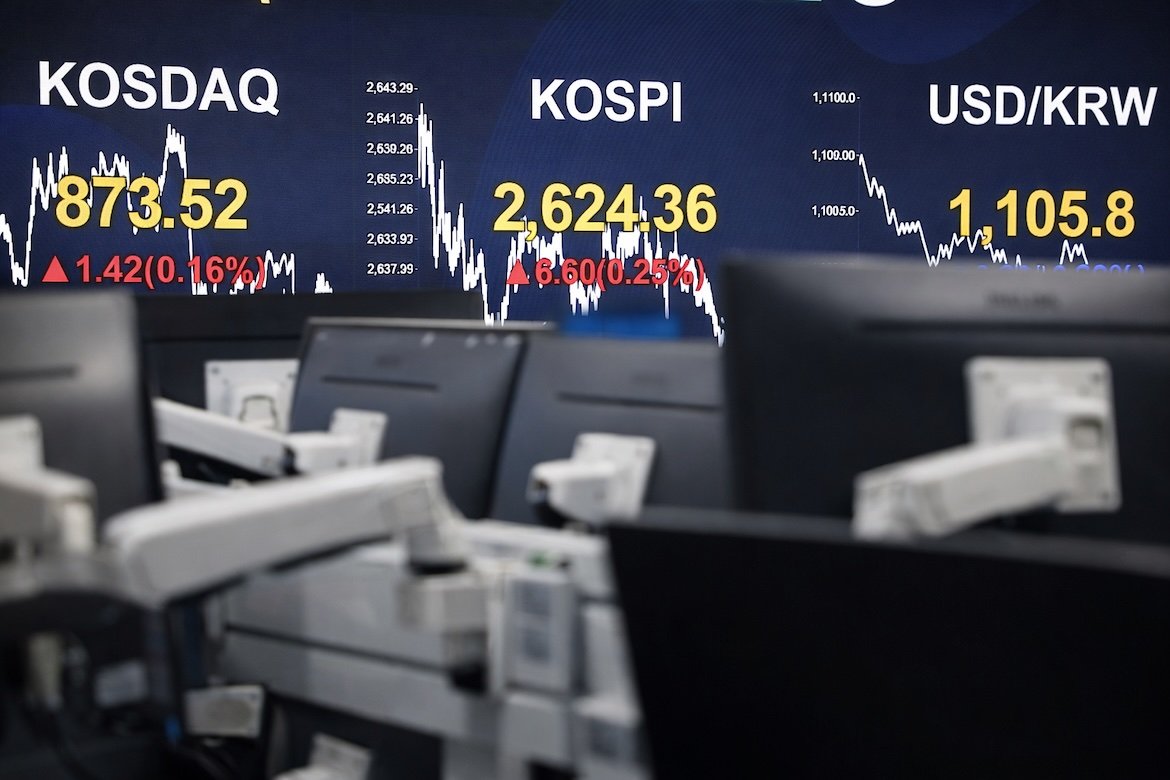
Asian markets tumbled amid rising geopolitical tensions and energy supply fears. South Korea’s KOSPI plunged more than 11%, while Thailand halted trading after an 8% intraday drop.
By Michael Foster | Edited by Oleg Petrenko
Published:
Asian markets fell sharply amid escalating geopolitical tensions and concerns over energy supply disruptions. South Korea’s KOSPI plunged more than 11%, while Thailand halted trading after an 8% intraday decline. Photo: bada.kbs.co.kr / Wikimedia
Asian markets opened sharply lower as geopolitical tensions and concerns over potential disruptions to global energy supplies triggered a wave of selling across the region.
Dubai’s benchmark stock index dropped 4.7% at the open, reflecting broad investor risk aversion as markets reacted to the escalating crisis in the Middle East.
Across Asia, the selloff intensified as traders reassessed economic risks tied to rising energy costs and regional instability.
South Korea’s KOSPI Suffers Deepest Drop Since Crisis
The sharpest decline came from South Korea, where the KOSPI index plunged more than 11% in a single trading session. The two-day drop now ranks among the steepest since the 2008 global financial crisis following the collapse of Lehman Brothers.
Technology companies led the decline, dragging the broader market lower as investors sold growth and export-oriented stocks. The selloff also weakened the Korean won, reflecting capital outflows and rising demand for defensive assets.
Analysts say the combination of geopolitical uncertainty and energy supply fears is particularly sensitive for South Korea’s export-driven economy, which relies heavily on stable global trade conditions.
As previously covered, rapid market declines in Asia often amplify global volatility because the region serves as an early signal of investor sentiment before U.S. and European markets open.
Thailand Halts Trading After 8% Market Drop
Thailand’s stock market also experienced a dramatic selloff. The benchmark SET index dropped more than 8% during the session, marking the largest intraday decline since March 2020.
The fall was severe enough to trigger a circuit breaker mechanism designed to slow panic selling. Authorities temporarily halted trading on index futures, options, and selected equities on the Thailand Futures Exchange (TFEX) to stabilize market conditions.
Circuit breakers are typically activated during extreme volatility to prevent disorderly market behavior and allow investors time to reassess positions.
The sharp declines across Asian markets highlight how geopolitical developments are rapidly spilling into financial markets. Investors remain cautious as energy prices, currency movements, and global equity markets continue to react to unfolding events.
For now, analysts warn that volatility may persist across global markets as traders digest geopolitical developments and their potential impact on economic growth.
Global markets plunged as soaring energy prices tied to the Middle East conflict triggered widespread selling across equities, bonds, metals, and crypto. More than $4.7 trillion in value was erased within hours.
By Michael Foster | Edited by Oleg Petrenko
Published:
Global markets plunged as soaring energy prices tied to the Middle East conflict triggered widespread selling across equities, bonds, metals, and crypto. More than $4.7 trillion in value was erased within hours. Photo: Anton Uniqueton / Pexels
Global financial markets have entered a period of extreme turbulence as rising energy prices and escalating conflict in the Middle East trigger widespread selling across asset classes. Stocks, bonds, precious metals, and cryptocurrencies have all come under pressure as investors reassess growth and inflation risks.
In Europe, the broad STOXX Europe 600 index fell 3.2%, while Germany’s DAX dropped 3.7% as markets reacted to the sharp increase in energy costs. Government bonds also faced heavy selling pressure, particularly across European markets, where higher energy prices are fueling concerns about inflation and economic slowdown.
The selloff reflects growing fears that the conflict could trigger a stagflationary shock, combining slower economic growth with rising costs.
Energy Prices Drive Market Panic
Oil prices have surged as supply concerns intensify. U.S. crude climbed above $77 per barrel, marking its highest level since January 21, 2025 – the day after President Donald Trump’s inauguration – effectively reversing the entire decline in oil prices seen during his presidency.
Natural gas prices have also surged. According to reports from Sky News, gas prices in the United Kingdom have jumped 93%, with the benchmark price exceeding $700 for the first time since 2023.
The surge in energy costs has raised alarm across financial markets. Emmanuel Cau, head of European equity strategy at Barclays, described the market reaction bluntly: “This is panic selling. This is fear of stagflation. The market underestimated the scale of this war.”
Higher energy costs threaten to ripple through global supply chains, raising inflation pressures and complicating central bank policy decisions.
Trillions Wiped Out Across Asset Classes
The market turmoil has erased an estimated $4.7 trillion across major asset classes within roughly 11 hours. Precious metals experienced some of the largest declines after earlier surges.
Gold fell 7%, wiping out roughly $2.6 trillion in market value, while silver dropped 12.3%, erasing about $610 billion.
Equity markets also took heavy losses. The S&P 500 declined 1.88%, destroying about $1.14 trillion in capitalization. The Nasdaq fell 2.13%, losing approximately $845 billion, while the Russell 2000 dropped 3.17%, wiping out roughly $100 billion.
Cryptocurrencies were not immune. Bitcoin slipped about 3%, reducing the market’s value by roughly $40 billion.
The scale and speed of the selloff highlight how sensitive global markets have become to geopolitical shocks. Rapid cross-asset movements suggest investors are quickly repricing risk across commodities, equities, and digital assets simultaneously.
For now, markets remain on edge as energy prices, geopolitical developments, and macroeconomic fears collide. Analysts warn that volatility could remain elevated until clearer signals emerge regarding both the conflict and the stability of global energy supply.
Apple introduced M5 Pro and M5 Max chips alongside updated MacBook Pro models focused on peak performance and on-device AI. The company also launched new Studio Displays, refreshed the iPad Air with M4, and revealed the iPhone 17e starting at $599.
By Emma Clarke | Edited by Oleg Petrenko
Published:
Apple unveiled its new M5 Pro and M5 Max chips with upgraded MacBook Pro models emphasizing top-tier performance and on-device AI capabilities. The company also introduced updated Studio Displays, a refreshed M4-powered iPad Air, and the iPhone 17e priced from $599. Photo: Apple
Apple unveiled a broad refresh of its hardware lineup, introducing new MacBook Pro models powered by M5 Pro and M5 Max chips, updated external displays, a refreshed iPad Air, and the new iPhone 17e. The announcements reinforce Apple’s strategy of driving performance upgrades while emphasizing advanced AI processing directly on device.
The new 14-inch MacBook Pro with M5 Pro starts at $2,199 in the U.S., while the 16-inch configuration with M5 Max reaches up to $3,899. Student pricing is available at lower entry points. Apple also introduced a new MacBook Air powered by the M5 chip, which maintains the same design as its predecessor but benefits from the upgraded silicon.
M5 Chips Focus on Performance and On-Device AI
The M5 Pro and M5 Max chips are positioned as performance-focused upgrades aimed at professionals working with AI models, high-end creative software, and demanding computational tasks. Apple emphasized enhanced neural engine capabilities and improved efficiency, reinforcing its push toward on-device AI rather than cloud-reliant processing.
Alongside the laptops, Apple launched updated Studio Display models, including a standard Studio Display priced at $1,600 and a higher-end Studio Display XDR at $3,300. The monitors are designed to complement the performance gains of the new MacBook Pro lineup.
As previously covered, Apple’s silicon strategy continues to differentiate it from competitors by tightly integrating hardware and software. The company is leaning into AI performance at the device level, positioning its chips as capable of handling advanced workloads without relying solely on external servers.
iPad Air M4 and iPhone 17e Expand Lineup
The company also introduced a new iPad Air powered by the M4 chip, marking the second major product reveal this week. The updated tablet now includes 12 GB of RAM, up from 8 GB previously, and integrates the N1 and C1X connectivity chips derived from recent iPhone models. It supports Wi-Fi 7 and maintains the same pricing structure, starting at $599 for the 11-inch 128 GB Wi-Fi version and reaching $1,449 for the 13-inch 1 TB cellular configuration.
In addition, Apple revealed the iPhone 17e, with the base model starting at $599 and offering 256 GB of storage as standard. Preorders open Wednesday, March 4, with retail availability beginning March 11.
The broad hardware refresh suggests Apple is prioritizing incremental but meaningful performance upgrades over radical redesigns. Investors will likely focus on whether AI-enhanced devices can drive upgrade cycles and sustain revenue momentum in a competitive consumer electronics market.
Roughly $1 trillion in market value evaporated from U.S. equities shortly after the opening bell as global markets extended losses tied to escalating Middle East tensions. Futures across the U.S., Europe, and Asia moved sharply lower.
By Sophia Reynolds | Edited by Oleg Petrenko
Published:
About $1 trillion in market capitalization was wiped from U.S. equities soon after the opening bell as global markets deepened losses linked to escalating tensions in the Middle East. Futures in the U.S., Europe, and Asia all moved decisively lower. Photo: Dustin D. / Pexels
U.S. equities erased approximately $1 trillion in market capitalization shortly after the opening bell, intensifying a global selloff driven by escalating tensions in the Middle East. The sharp drop marks a steeper opening decline than the previous session, underscoring mounting investor anxiety.
The early losses reflect a broad risk-off move as markets react to geopolitical uncertainty and rising energy prices. Investors are rotating out of equities while bracing for continued volatility across asset classes.
U.S. Futures Extend Global Weakness
Yesterday’s session also opened in negative territory, though declines were more contained than today’s sharp drop. At that time, U.S. futures pointed to losses of about 1.5% for the Dow Jones Industrial Average and the S&P 500, while the Nasdaq fell roughly 1.7%.
European markets followed suit, with Germany’s DAX and France’s CAC both down more than 2%. In Asia, Japan’s Nikkei declined about 1.5%, and Hong Kong’s Hang Seng fell roughly 2%.
Notably, Tel Aviv’s market remained in positive territory despite broader regional tensions, reflecting localized investor dynamics and sector positioning.
Volatility Intensifies Across Regions
The scale of today’s U.S. opening loss $1 trillion in capitalization – signals a deepening repricing of risk. As previously covered, synchronized declines across the U.S., Europe, and Asia often reflect macro-driven flows rather than company-specific developments.
Market participants are closely watching oil prices, bond yields, and safe-haven flows for signs of stabilization. Elevated geopolitical risk premiums and rapid capital rotation are increasing intraday volatility, making sharp reversals more likely.
Analysts warn that if tensions continue to escalate, equity markets could remain under pressure in the near term. Conversely, any signs of de-escalation may trigger equally swift rebounds, given the scale of short-term positioning.
For now, global markets remain firmly in risk-off mode, with investors prioritizing capital preservation amid heightened uncertainty.
Gold surged above $5,400 after reports of a drone strike on Saudi Aramco’s largest refinery, triggering a rush into safe-haven assets. Within an hour, however, both gold and silver sharply reversed as volatility intensified.
By Nathan Cole | Edited by Oleg Petrenko
Published:
Gold jumped above $5,400 following reports of a drone strike on Saudi Aramco’s largest refinery, sparking a flight to safe-haven assets. Within an hour, however, both gold and silver reversed sharply as market volatility accelerated. Photo: Zlaťáky.cz / Pexels
Gold prices surged past $5,400 per ounce early this morning after reports that an Iranian drone struck Saudi Arabia’s largest oil refinery operated by Saudi Aramco. The geopolitical escalation triggered an immediate rush into safe-haven assets, pushing precious metals sharply higher in early trading.
The spike underscored how quickly geopolitical shocks are being priced into commodities markets. Investors moved aggressively into gold and silver amid fears of energy supply disruptions and broader regional instability.
However, the rally proved short-lived as markets swung violently in both directions within the hour.
Initial Safe-Haven Surge
Following confirmation of the refinery strike, gold extended gains and briefly traded above the $5,400 threshold. Silver also jumped sharply in tandem, reflecting classic defensive positioning during geopolitical crises.
As previously covered, energy infrastructure attacks in the Middle East often fuel safe-haven demand in precious metals due to inflation and supply shock risks. The immediate reaction suggested traders were pricing in a potential escalation that could disrupt oil production and shipping routes.
The early surge added billions to the combined market capitalization of gold and silver within minutes.
Sharp Intraday Reversal
Yet within the last hour, the metals complex experienced a sudden and dramatic reversal. Spot silver prices plunged 7%, falling toward $88 per ounce, while gold dropped nearly $100 per ounce from its intraday peak.
The abrupt selloff highlights the extreme volatility now gripping commodities markets. Analysts point to profit-taking, leveraged position unwinds, and algorithmic trading flows as potential drivers of the sharp reversal.
Such rapid two-way swings suggest liquidity remains fragile, with markets highly sensitive to headlines and positioning. The speed of the decline indicates that some of the earlier surge may have been fueled by short-term speculative flows rather than sustained long-term demand.
Investors are now bracing for continued turbulence as geopolitical developments unfold. If tensions escalate further, safe-haven flows could resume just as quickly as they faded.
For now, the episode underscores the fragile equilibrium in global commodities markets where prices can spike on fear and reverse just as violently on shifting expectations.
Markets turned sharply volatile as escalating tensions between the U.S., Israel, and Iran drove investors into safe-haven assets. Gold neared record highs while oil spiked nearly 12%, and U.S. equity futures fell.
By Nathan Cole | Edited by Oleg Petrenko
Published:
Markets swung sharply amid rising tensions between the U.S., Israel, and Iran, prompting investors to seek safety in defensive assets. Gold approached record levels, oil surged nearly 12%, and U.S. equity futures moved lower. Photo: Engin Akyurt / Pexels
Global markets swung sharply as escalating tensions between the United States, Israel, and Iran triggered a flight to safety and renewed fears of broader regional conflict. Investors rotated aggressively into precious metals while equity futures moved lower and energy prices surged.
Gold jumped between 2% and 2.5% in the first hour of trading, adding roughly $750 billion to its market capitalization and approaching its all-time high, now just 3.6% below the record. Silver also advanced, rising about 2.1% at one point and adding approximately $112 billion in market value.
The moves signal a rapid shift in investor positioning as geopolitical risk premiums re-enter global asset pricing.
Safe Havens Rally as Equities Slip
The surge in gold reflects renewed demand for defensive assets during periods of geopolitical instability. As previously covered, gold often benefits from uncertainty surrounding military conflict, currency volatility, and energy supply disruptions.
Meanwhile, U.S. equity futures turned negative. The S&P 500 fell 0.8%, the Nasdaq 100 declined 0.94%, and the Dow Jones Industrial Average dropped 1.26% in early trading. The selloff suggests investors are reducing exposure to risk assets amid uncertainty over potential escalation.
Energy markets reacted even more dramatically. Oil prices briefly surged nearly 12%, climbing toward $75 per barrel before partially retracing gains. The spike underscores concerns about potential supply disruptions in the Middle East, a region critical to global crude production and transport routes.
Bitcoin, often viewed as a speculative risk asset, remained resilient and held modest gains of around 1.5%, suggesting a more complex cross-asset reaction than in previous geopolitical episodes.
Volatility Expected to Intensify
Analysts warn that the coming week could be exceptionally volatile as markets digest geopolitical developments, energy price movements, and potential diplomatic responses. Sudden shifts in headlines could drive sharp intraday reversals across commodities, equities, and digital assets.
The combination of rising oil prices and falling equity futures also introduces inflationary concerns, as sustained energy spikes could complicate central bank policy expectations.
For now, the immediate reaction reflects classic risk-off dynamics: capital flowing into gold, defensive positioning in commodities, and cautious sentiment in equities. Whether the volatility persists will depend on the trajectory of the conflict and the extent of global diplomatic engagement.
Investors are bracing for rapid swings as geopolitical risk once again becomes a dominant market driver.
Join our list to receive latest Blockchain, Crypto & Fintech news:
WordPress database error: [Table 'u752143311_Kem9N.wp_coingecko_coins' doesn't exist]
            SELECT coins.*, meta.post_id as post_id
            FROM `wp_coingecko_coins` coins
            INNER JOIN wp_postmeta meta ON (meta.meta_key = 'wpcf-coin-main-tag' AND meta.meta_value = coins.slug )
            ORDER BY market_cap_usd
            DESC LIMIT 9